You heard someone say qalbi — maybe in a song, a drama, or a whispered conversation — and it stopped you. There’s something about the way it sounds. Soft yet heavy. Familiar yet foreign. So you typed it into Google because you needed to know what it really means, not just a one-word translation.
Here’s the thing — qalbi meaning in Arabic goes far deeper than most quick-answer sites will tell you. In this post, you’ll discover where the word comes from, how it’s used across different Arabic dialects, what it means in Islamic tradition, and why people around the world use it to express love in a way no other word quite captures. Stick around — by the end, this little word will mean a lot more to you.
What Does Qalbi Mean in Arabic? (Quick Answer)
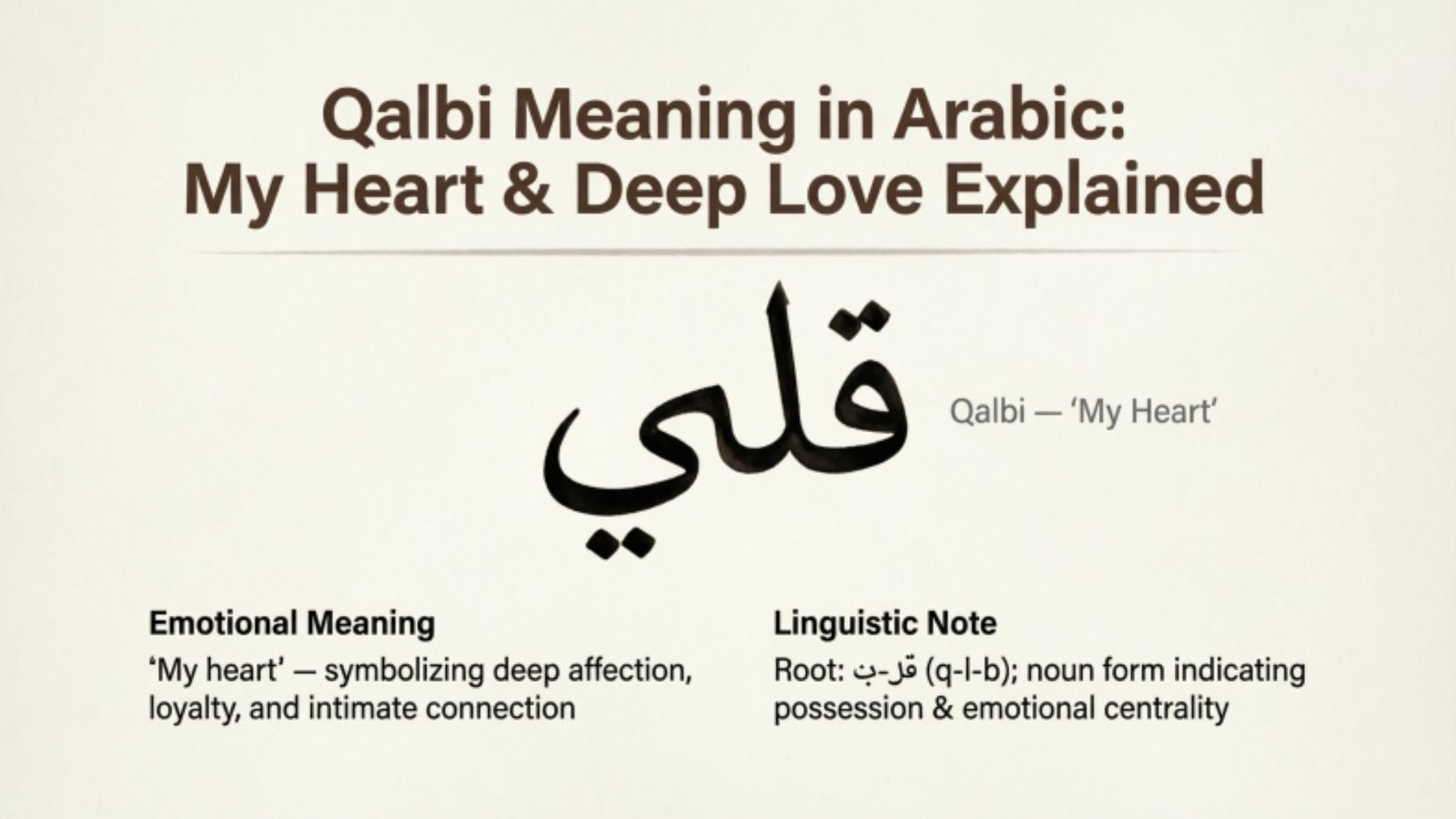
Qalbi (قلبي) means “my heart” in Arabic. It combines qalb (قلب) — the Arabic word for heart — with the possessive suffix -i, which means “my.” So when someone says qalbi, they’re literally saying: my heart.
But here’s where it gets interesting. Qalbi meaning in Arabic carries far more emotional weight than the English word “heart” ever could. In Arab culture, the heart isn’t just an organ — it’s the seat of your feelings, your soul, and your sincerity. When someone calls you qalbi, they’re not handing you a biology lesson. They’re offering you the most tender, heartfelt expression of deep affection in their language.
Think of it this way. In English, you might say “you mean everything to me.” In Arabic, they simply say qalbi — and somehow, those two syllables say it all. This term of endearment travels across lovers, mothers, friends, and even strangers in moments of warmth and tenderness. It’s the kind of word that makes your chest feel full just hearing it.
Arabic is a language built on emotional closeness, and qalbi sits right at the center of that. From Quranic verses to Arabic poetry, from Nancy Ajram’s songs to everyday conversations in Cairo and Beirut — this single word shows up wherever people want to express something from their innermost feelings. It’s not just a word. It’s a feeling with a name.
The Root Word: Where Does Qalbi Come From?
Arabic is built on a fascinating system of triliteral roots — three consonants that carry a core meaning, with words branching out from that single trunk. The root behind qalbi is Q-L-B (ق-ل-ب), and its original meaning is to flip, turn, or transform. That’s not a coincidence. The heart, in Arabic thought, is the thing that turns — toward love, toward faith, toward God. Even Allah’s name Al-Muqallib comes from this same root, meaning the Turner of Hearts. The Prophet Muhammad ﷺ himself referred to this in a hadith recorded in Musnad Ahmad, describing the heart as more changeable than a feather tossed by desert wind.
From that one root, Arabic builds a whole family of words — each connected, each meaningful. Here’s how qalbi fits into that family:
| Arabic | Transliteration | Meaning |
| قلب | Qalb | Heart (base noun) |
| قلبي | Qalbi | My heart (with possessive suffix -i) |
| قلوب | Quloob | Hearts (broken plural form) |
| مقلوب | Maqlub | Flipped / upside down |
| انقلاب | Inqilab | Revolution / overturn |
The grammar here is beautifully simple. In Modern Standard Arabic, you attach the possessive suffix -i to a noun to mean my. So qalb becomes qalbi — my heart. It’s the same pattern across Arabic: bayt (house) becomes bayti (my house). Clean, direct, and deeply expressive.
- Q-L-B = the triliteral root — core meaning: to flip or turn
- Qalb = the standalone noun — simply means “heart”
- Qalbi = qalb + the Arabic possessive suffix -i = “my heart”
- Quloob = the broken plural — used when referring to multiple hearts
- Maqlub = something flipped — yes, the famous Arab dish shares this root
- Inqilab = a complete overturn — used for political revolutions across the Arab world
How to Pronounce Qalbi Correctly (Qalbi vs Kalbi)
This is where a lot of people — especially on TikTok — make a genuinely awkward mistake. Saying kalbi instead of qalbi seems harmless until you realize that kalbi (كلبي) means “my dog” in Arabic. So if you’re trying to tell someone they’re your heart and you mispronounce it, you’ve just called them your pet. 🐶 Not exactly the romantic moment you were going for.
The difference comes down to one single sound — the first letter. Qalbi starts with the Arabic letter Qaf (ق), a deep, guttural sound produced at the back of your throat. It has no direct equivalent in English, which is exactly why non-native speakers default to a simple K sound. Here’s how to get it right, step by step:
- The Q sound — press the back of your tongue against the very back of your throat, almost like you’re about to gargle. It’s deeper than K and feels like the sound comes from your chest, not your lips
- The Q sound in IPA — transcribed as /q/, it’s a uvular stop. The full IPA pronunciation of qalbi is /ˈqalbiː/
- Kalbi (كلبي) — starts with Kaf (ك), a regular K sound like in “king” — means my dog 🐶
- Qalbi (قلبي) — starts with Qaf (ق), the deep guttural Q — means my heart ❤️
- Practice tip — say the word “caught” and push that K sound deeper into your throat until it feels almost like a light cough. That’s your Q
| Word | Arabic | Pronunciation | Meaning |
| Qalbi | قلبي | /ˈqalbiː/ — deep guttural Q | My heart ❤️ |
| Kalbi | كلبي | /ˈkalbiː/ — regular K sound | My dog 🐶 |
| Qalb | قلب | /qalb/ | Heart |
| Kalf | كلب | /kalb/ | Dog |
Gulf Arabic speakers naturally produce the deep qaf sound — it’s baked into their dialect. Levantine speakers, however, often soften or drop the qaf entirely, which is why you’ll hear albi or alby in Lebanese and Syrian speech. Egyptian Arabic sits somewhere in the middle, with many speakers replacing qaf with a glottal stop — so it sounds closer to ‘albi. Different sound, same beautiful meaning.
Ya Qalbi Meaning — “Oh My Heart” Explained
In Arabic, ya (يا) is a calling particle — think of it as “oh” in English, used to directly address someone. It’s how Arabs call out to a person, a feeling, or even God. So when you put ya in front of qalbi, you get ya qalbi (يا قلبي) — literally “oh, my heart.” But in real life, it’s so much warmer than that. It’s the kind of phrase that melts walls and softens rooms.
Arabs use ya qalbi the way some people say “my love” or “my darling” — except it hits deeper. A mother whispers it to her child when she pulls them close. A lover says it in a moment too full for ordinary words. Even a close friend might say it when someone shares good news or does something unexpectedly kind. It’s not reserved for romance alone — it belongs to anyone your heart genuinely holds. Here are some real examples of how it sounds in everyday Arabic:
- يا قلبي، كيف حالك؟ Ya qalbi, kayfa halak? — “Oh my heart, how are you?” (warm, affectionate check-in)
- يا قلبي، أنا هنا معك Ya qalbi, ana huna ma’ak — “Oh my heart, I’m right here with you” (comforting expression)
- يا قلبي، اشتقت إليك كثيراً Ya qalbi, ishtaqtu ilayka kathiran — “Oh my heart, I’ve missed you so much” (deep emotional longing)
- يا قلبي، أنت كل شيء Ya qalbi, anta kullu shay’ — “Oh my heart, you are everything” (unconditional love)
What to Reply When Someone Says Ya Qalbi
So someone just said ya qalbi to you — and now you’re staring at your screen wondering what on earth to say back. Don’t worry. Arabs have a whole natural vocabulary for these moments and the replies are just as warm as the phrase itself. Here’s exactly what you can say:
- يا روحي — Ya rohi — “Oh my soul” — the most natural, equally tender response. It tells them they’re not just your heart — they’re your soul
- أنت قلبي / أنتِ قلبي — Anta qalbi (to a male) / Anti qalbi (to a female) — “You are my heart” — gives the feeling right back to them
- حبيبي / حبيبتي — Habibi (to a male) / Habibti (to a female) — “My beloved” — warm, classic, never wrong
- وأنت يا حياتي — Wa anta ya hayati — “And you, oh my life” — a beautiful, poetic way to match their energy
- قلبي معك دائماً — Qalbi ma’ak da’iman — “My heart is always with you” — sincere, heartfelt, and deeply Arabic in spirit
Qalbi in Arabic Love & Romance — How Arabs Use It
In Arabic, love isn’t just spoken — it’s layered. Arabs rarely stop at one term of endearment when two or three feel more honest. Qalbi sits at the heart of romantic Arabic expressions, and it pairs beautifully with other love words to create phrases that carry real emotional weight. Whether it’s a late-night text or a line from a classic song, these phrases show up wherever Arabic love lives.
Here are the most used romantic phrases built around qalbi:
| Arabic | Transliteration | English Meaning |
| أنت قلبي | Anta qalbi | You are my heart (to male) |
| أنتِ قلبي | Anti qalbi | You are my heart (to female) |
| حبيبي قلبي | Habibi qalbi | My beloved, my heart (to male) |
| حبيبتي قلبي | Habibti qalbi | My beloved, my heart (to female) |
| حياتي وقلبي | Hayati wa qalbi | My life and my heart |
| من قلبي | Min qalbi | From my heart |
| قلبي يحبك | Qalbi yuhibbuk | My heart loves you |
| قلبي مكسور | Qalbi maksur | My heart is broken |
Habibi Qalbi Meaning — Double Affection Explained
Habibi qalbi is essentially Arabic affection turned up to full volume. Habibi (حبيبي) means “my beloved” and qalbi means “my heart” — so together, it’s like saying “my beloved, my heart” in one breath. It’s not redundant — it’s intentional. Arabs layer love words the way poets layer metaphors — each one adds depth, not repetition. You’ll hear it in songs, read it in texts, and feel it in moments where one word simply isn’t enough.
- Habibi qalbi — used with males
- Habibti qalbi — used with females
- Common in Egyptian and Levantine Arabic texts and love songs
- Abdel Halim Hafez built entire verses around this kind of double endearment
Comparison Table: Qalbi vs Habibi vs Hayati vs Ruhi
Arabic doesn’t give you just one word for love — it gives you an entire spectrum. Each term sits at a different emotional depth, used in different moments, for different people. Knowing which word to use (and when) is what separates someone who speaks Arabic from someone who feels it. Here’s a clean breakdown of the six most powerful Arabic terms of endearment, ranked by emotional intensity:
| Arabic | Transliteration | Meaning | Used For | Intensity |
| حبيبي/حبيبتي | Habibi / Habibti | My beloved | Anyone loved — friend, partner, family | ⭐⭐⭐ Warm |
| قلبي | Qalbi | My heart | Lover, child, very close friend | ⭐⭐⭐⭐ Deep |
| حياتي | Hayati | My life | Romantic partner | ⭐⭐⭐⭐ Deep |
| روحي | Ruhi | My soul | Soulmate, deep love | ⭐⭐⭐⭐⭐ Profound |
| فؤادي | Fu’adi | My innermost heart | Poetic, classical — rare in speech | ⭐⭐⭐⭐⭐ Profound |
| عمري | Omri | My life / my age | Egyptian Arabic — deeply romantic | ⭐⭐⭐⭐ Deep |
No competitor has mapped these six words side by side with intensity levels — and that’s exactly why this table matters. Each word tells a different love story. Habibi is warm and wide — Arabs use it with almost anyone they’re fond of. Qalbi gets more specific — it means you’ve claimed a place inside someone’s chest. Hayati says you are their entire life. Ruhi goes further still — you’re not just loved, you’re part of their soul. And fu’adi? That’s the word Arabic poets like Al-Mutanabbi reached for when qalb didn’t feel deep enough. It refers to the innermost core of the heart — a word so intimate it barely survives outside classical Arabic and Sufi poetry. Rumi himself circled this territory, writing about divine love in ways that blur the line between human affection and spiritual longing — wajd, shaghaf, mawadda — all flowing from the same sacred well.
Qalbi in Islam & the Quran — The Spiritual Heart
In Islam, the qalb is far more than a physical organ. It’s the center of faith, intention, and moral consciousness — the place where belief either takes root or withers. Allah addresses this directly in Surah Al-Hajj (22:46): “It is not the eyes that go blind, but the hearts within the chests.” That single verse repositions everything. In the Quranic worldview, your qalb is your true seeing organ — the one that recognizes truth, feels taqwa (piety), and turns toward or away from God. This is why one of Allah’s most profound names is Al-Muqallib — the Turner of Hearts. The Prophet Muhammad ﷺ would frequently make dua: “Ya Muqallib al-quloob, thabbit qalbi ‘ala dinik” — “O Turner of Hearts, keep my heart firm on Your religion.”
The Sufi tradition takes this even deeper. Ibn Arabi, the great Andalusian mystic, described the qalb as a divine mirror — capable of reflecting God’s light when polished through ikhlas (sincerity) and remembrance. For Ibn Arabi, the heart wasn’t just a vessel for emotion — it was the only organ capable of containing divine love in its fullest form. This is why the dua Allahumma tahhir qalbi — “O Allah, purify my heart” — carries such weight in Islamic practice. It’s not asking for emotional healing alone. It’s asking for spiritual clarity, moral alignment, and closeness to God. Muslims across the world repeat variations of this supplication daily, making qalbi one of the most spiritually loaded words in the entire Arabic language.
Qalbi fil Madinah — Meaning of the Famous Phrase
Qalbi fil Madinah (قلبي في المدينة) means “my heart is in Madinah” — and for millions of Muslims around the world, that’s not poetry. It’s a lived feeling. The phrase comes from a deeply beloved nasheed that expresses spiritual longing for the city of the Prophet Muhammad ﷺ — Al-Madinah Al-Munawwarah, the illuminated city. It captures something that Muslims — especially those in the diaspora across the USA, UK, and beyond — carry quietly in their chests: a homesickness for a place many have never even visited yet somehow miss deeply.
The nasheed resonates because it gives language to sakinat qalbi — the peace of heart that Muslims associate with Madinah’s spiritual atmosphere. It’s not just about geography. It’s about noor qalbi — the light of the heart — being drawn toward the resting place of the Prophet ﷺ. When someone says qalbi fil Madinah, they’re expressing the highest form of spiritual love in Islam: a heart so oriented toward faith that even its longing has a direction.
Qalbi Across Arabic Dialects
One of the most beautiful things about Arabic is this: the word changes shape as it travels from country to country but the feeling it carries never does. Qalbi in Gulf Arabic, albi in Cairo, galbi in Casablanca — same heart, different accent. This is the magic of the Arabic root system. The triliteral root Q-L-B stays intact across every dialect. What shifts is simply how each region’s tongue shapes the qaf sound — and that one sound creates a whole spectrum of regional variations.
Here’s how qalbi sounds across the Arab world:
| Dialect | Region | Pronunciation | Written Form | Notes |
| Gulf Arabic | Saudi, UAE, Kuwait | Qalbi | قلبي | Deep guttural Q — closest to Classical Arabic |
| Egyptian Arabic | Egypt, Cairo | Albi / Alby | قلبي | Qaf drops to glottal stop — sounds like ‘albi |
| Levantine Arabic | Lebanon, Syria, Palestine | Albi / Ya albi | قلبي | Soft, melodic — qaf becomes glottal or silent |
| Moroccan Arabic | Morocco, Maghreb | Galbi / Qalbi | قلبي | Qaf shifts to G sound in Darija |
| Iraqi Arabic | Iraq, Baghdad | Chalbi / Qalbi | قلبي | Qaf sometimes shifts toward Ch sound |
| Maltese | Malta | Qalbi | qalbi | Retained from Arabic — Semitic family connection |
- Gulf Arabic keeps the deep qaf sound — it’s the most classical pronunciation and sits closest to Modern Standard Arabic
- Egyptian Arabic is the most widely understood dialect globally thanks to Egyptian TV and music — so albi and alby are the versions most non-Arabs recognise first
- Levantine Arabic softens everything beautifully — ya albi in a Lebanese accent sounds almost like a song on its own
- Moroccan Darija shifts the qaf to a hard G — so galbi is their natural form, though educated speakers may use qalbi in formal settings
- Iraqi Arabic adds its own regional flavor — the qaf occasionally shifts toward a ch sound depending on the speaker and city
- Maltese is a fascinating case — it’s the only Semitic language written in Latin script and spoken in Europe, yet qalbi survives in it almost unchanged, a quiet reminder of Arabic’s deep historical roots in Malta
So when you search alby meaning or albi meaning in Arabic — you’re not finding a different word. You’re finding the same qalbi, just wearing a different regional coat.
Qalbi in Arabic Songs, Poetry & Pop Culture
If you want to understand how deeply qalbi lives in Arab culture, just press play. The word doesn’t sit quietly in dictionaries — it sings. It has been carried through decades of Arabic music, whispered in classical poetry, and now it trends on TikTok with millions of views. From the golden era of Egyptian cinema to a teenager’s Instagram caption in Dubai — qalbi shows up wherever Arabs want to say something real. The word has become a cultural heartbeat, pulsing through every generation and every platform.
Here are three iconic examples that show exactly how qalbi moves through Arab culture:
- “Ya Albi” — Nancy Ajram 🎵 Nancy Ajram’s Ya Albi is pure Lebanese warmth bottled into a pop song. She uses ya albi as a direct address — singing straight to the heart of a loved one with that signature Levantine softness. The song captures everyday emotional closeness rather than dramatic heartbreak. It’s the kind of track Arabs play when they want to say “I love you” without making it complicated
- “Qalbi Ya Qalbi” — Abdel Halim Hafez 🎵 Abdel Halim Hafez was Egypt’s most beloved singer and this song is a masterclass in Arabic emotional depth. He sings to his own heart — questioning it, blaming it, loving it anyway. It reflects the classical Arabic poetry tradition where the heart is treated as a separate entity, almost a companion with its own will. Al-Mutanabbi wrote verses in this same spirit centuries earlier — talking to the heart as if it were a person
- “Qalbi fil Madinah” 🎵 This nasheed transcends pop culture entirely. It’s spiritual longing set to melody — a song that makes millions of Muslims feel the pull toward Madinah even from thousands of miles away. It goes viral every Ramadan and Hajj season without fail. On TikTok, you’ll find countless videos of pilgrims arriving in Madinah with this nasheed playing in the background — and the comment sections are always full of people typing ya qalbi through tears
- TikTok & Instagram 📱 The qalbi trend on TikTok exploded largely because of the qalbi vs kalbi moment — people discovering that one mispronunciation turns “my heart” into “my dog.” But beyond the humor, Arabic love phrases have become genuinely popular in global social media culture. Ya qalbi, habibi qalbi, and qalbi in Arabic calligraphy regularly appear in Instagram captions, tattoo designs, and Diwani script artwork shared across the Middle East and beyond
- Arabic Poetry & Classical Tradition 📜 Long before TikTok, qalbi lived in Arabic poetry. The Sufi poet Ibn Arabi used heart imagery to describe divine love in ways that still feel startlingly modern. Classical poets treated the qalb as the most honest part of a human being — the only part that couldn’t lie. That tradition flows directly into modern Arabic TV dramas, where ya qalbi is the line that always lands hardest in the most emotional scenes
Common Mistakes When Using Qalbi (And How to Fix Them)
Learning Arabic love words is exciting but it’s also surprisingly easy to slip up. A missing suffix here, a wrong consonant there — and suddenly your heartfelt expression lands completely wrong. The good news is that most mistakes people make with qalbi follow a clear pattern and once you see them, you won’t repeat them. Here are the most common errors and exactly how to fix each one:
- ❌ Saying kalbi instead of qalbi This is the most famous mistake — and the most embarrassing. Swap the deep guttural qaf for a regular K and you’ve just said “my dog” instead of “my heart.” Arabs will understand what you meant but they will absolutely laugh. Practice that deep throat Q sound — it’s worth the effort
- ❌ Saying anta qalb instead of anta qalbi Dropping the -i suffix changes everything. Qalb alone just means “heart” — a standalone noun with no personal connection. Qalbi means my heart — which is the whole point. Without that little -i, you’re not expressing love. You’re just naming a body part
- ❌ Using the wrong gender form Arabic is a gendered language and qalbi phrases change depending on who you’re speaking to. Many learners use anta qalbi (for males) with everyone — including females — which is grammatically incorrect
- ❌ Dialect mismatch Using Gulf-style qalbi with an Egyptian speaker sounds overly formal. Using albi with a Gulf Arabic speaker might feel too casual or unclear. Match the dialect to your audience where possible
- ❌ Using fu’adi casually Fu’adi is deeply classical and poetic. Dropping it into a casual text feels like quoting Shakespeare in a WhatsApp message — technically beautiful but socially odd
Here’s a quick correction table to keep handy:
| ❌ Mistake | ✅ Correction | Why It Matters |
| Kalbi (كلبي) | Qalbi (قلبي) | Kalbi means “my dog” — completely different word |
| Anta qalb | Anta qalbi | Missing -i removes the “my” — loses all affection |
| Anti qalbi → to a male | Anta qalbi → to a male | Anti is female form — use anta for males |
| Anta qalbi → to a female | Anti qalbi → to a female | Anta is male form — use anti for females |
| Using albi in Gulf context | Use qalbi in Gulf Arabic | Dialect mismatch sounds unnatural to native speakers |
| Fu’adi in casual texting | Stick to qalbi or habibi | Fu’adi is classical — too formal for everyday use |
The beauty of qalbi is that even when you get it slightly wrong, Arabs appreciate the effort. This is a language that rewards anyone who tries to speak it with sincerity — and sincerity, after all, is exactly what qalbi is all about.
FAQs
What does Qalbi mean in Arabic?
Qalbi (قلبي) means “my heart” in Arabic — a deeply emotional term combining qalb (heart) with the possessive suffix -i.
What does Ya Qalbi mean in English?
Ya Qalbi means “oh my heart” — a warm Arabic term of endearment used for lovers, children, and close friends.
What does Anta Qalbi mean?
Anta Qalbi (أنت قلبي) means “you are my heart” in Arabic — used when speaking to a male person you deeply love.
What does Enti Qalbi mean?
Enti Qalbi (أنتِ قلبي) means “you are my heart” — the female form, used when expressing deep love to a woman.
What can I call my lover in Arabic?
Call your lover habibi, qalbi, hayati, or ruhi — meaning beloved, my heart, my life, or my soul respectively.
What is “I love you” in Egyptian Arabic?
In Egyptian Arabic, “I love you” is Ana Bahibbak (to a male) or Ana Bahibbik (to a female) — warm and widely used.
What is Zikr Qalbi?
Zikr Qalbi means “remembrance of the heart” — a Sufi practice where the heart silently repeats Allah’s name with deep spiritual devotion.
What is the meaning of يا قلبي?
يا قلبي means “oh my heart” in Arabic — an affectionate calling phrase expressing love, warmth, and deep emotional closeness.
What is Qalbi fil Madinah?
Qalbi fil Madinah means “my heart is in Madinah” — a spiritual phrase expressing a Muslim’s deep longing for the Prophet’s ﷺ city.
Conclusion
Qalbi is one of those rare words that carries an entire world inside it. From its triliteral root Q-L-B to Quranic verses, from Egyptian pop songs to Sufi philosophy — this single word touches language, love, faith, and culture all at once. Now when someone says ya qalbi to you, you’ll know exactly how much weight those two syllables carry.
Whether you’re learning Arabic, exploring Islamic spirituality, or simply trying to understand a song that moved you — qalbi meaning in Arabic is your reminder that some languages don’t just communicate. They feel. Keep this word close. Use it honestly. And remember — in Arabic, calling someone your heart isn’t a metaphor. It’s the highest thing you can offer another person.



Leave a Reply