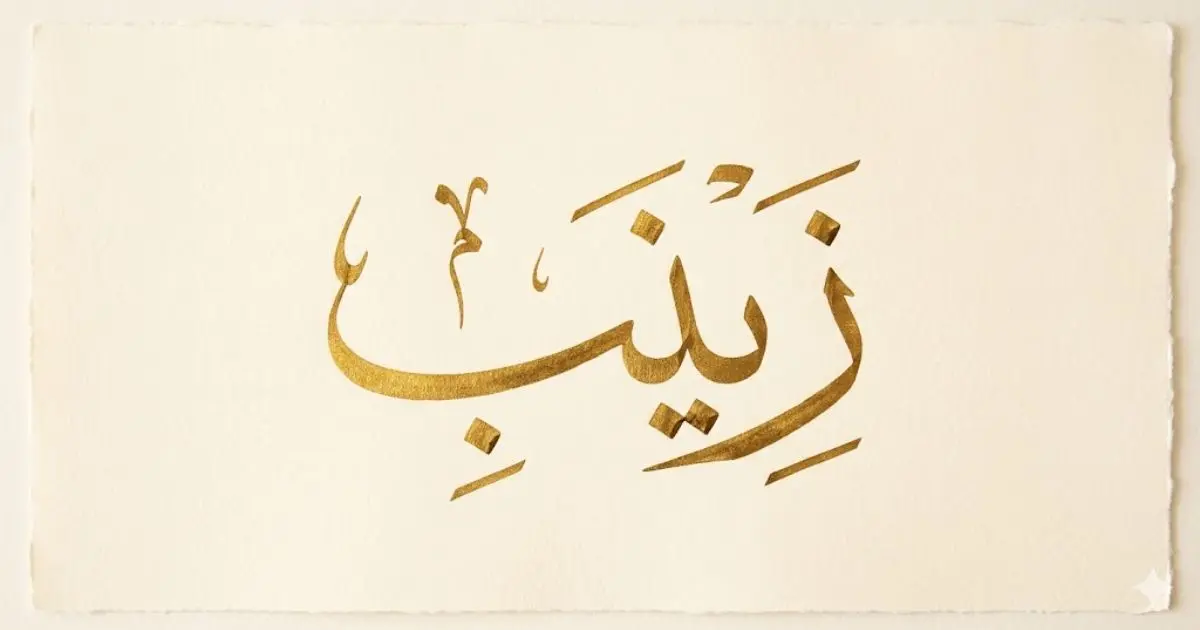
You’re holding your newborn daughter, and the name Zeinab keeps coming back to you. It sounds right — but what does it actually mean? And why have families across the Middle East, North Africa, and now the United States been giving it to their daughters for over 1,400 years?
In 2026, more parents than ever are searching for names that carry real cultural weight, not just a pretty sound. Zeinab — spelled زينب in Arabic — is one of those names. It’s rooted in two of the most beautiful concepts in the Arabic language, it’s connected to some of the most respected women in Islamic history, and it carries a depth that a quick Google search usually doesn’t capture.
This guide covers everything: the true Arabic meaning, the two-root linguistic debate, how to pronounce it across dialects, who the famous Zaynabs were, and what American Muslim families today say about choosing this name. Let’s get into it.
Knowledge Panel entity definition: Zeinab is a feminine Arabic name (written زينب) derived from the root زَيْن (zayn), meaning beauty or adornment, with historical significance as the name of the daughter and granddaughter of the Prophet Muhammad.
What Zeinab Means in Arabic — The Core Definition
Zeinab in Arabic means “fragrant flowering tree” or “beautiful ornament.” The name draws its power from the Arabic root زَيْن (zayn), which covers the ideas of beauty, adornment, and grace — the kind of beauty that enhances everything around it, not just surface looks. Most name databases give you a one-word answer like “beauty” or “desert,” but neither really captures what this name conveys to an Arabic speaker.
Think of it this way. In Arabic, زَيْن isn’t just “pretty.” It’s the word used when something adds worth and elegance to its surroundings. A piece of jewelry that makes an outfit shine is زَيْن. A person whose presence lifts a room carries زَيْن. That’s the quality built into this name at its root.
Some sources also translate Zeinab as referring specifically to a type of fragrant desert flowering tree — a plant prized in early Arabian culture for its beauty and its scent. Both interpretations are valid, and both point to the same idea: something naturally beautiful that you can’t ignore.
“A name is the first gift a parent gives — Zeinab is one that carries beauty in every syllable.”
The Two Arabic Roots Behind the Name
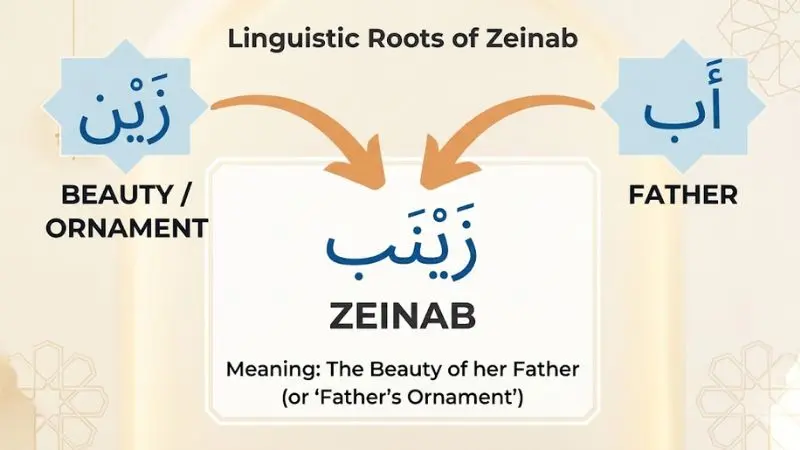
Theory 1: A single compound word
The name زينب (zaynab) existed in pre-Islamic Arabic as the name of a specific fragrant plant or flowering tree. In this reading, the name is a noun in its own right — named after a beautiful, sweet-smelling natural thing. This was a common naming tradition in early Arab culture, where girls were named after beautiful plants and flowers.
Theory 2: Two roots combined
The name is a compound of زَيْن (zayn) — beauty, adornment, grace — and أَب (ab) — father. Combined, it translates poetically as “the father’s adornment” or “the jewel of her father.” In my experience looking at classical Arabic name traditions, this interpretation is the one most Arabic-speaking families are actually familiar with and feel emotionally connected to. It frames the child as something precious that brings honor to her family.
Both theories are accepted by Arabic linguists. Many scholars hold that the original plant-name usage gave rise to the compound interpretation over time. Either way, the name’s emotional resonance is the same: beauty, preciousness, and grace that belongs to a family.
From our research into Arabic naming traditions: the “father’s adornment” interpretation is consistently the one cited by families in Egypt, Lebanon, and Iraq when asked why they chose this name — suggesting it’s the lived meaning, regardless of the academic debate.
How to Pronounce Zeinab Correctly
Zeinab is pronounced ZAY-nab — two syllables, stress on the first. The “ei” sounds like the “ay” in “say.” The final “b” is a clear, hard stop.
But here’s the thing: pronunciation actually shifts across Arabic dialects and cultures.
| Region/Culture | Spelling Variant | Pronunciation |
| Arabic (Classical/Gulf) | Zaynab | ZAY-nab |
| Persian/Iranian | Zeinab | ZAY-nab |
| Egyptian Arabic | Zeinab | ZEY-nab (softer first vowel) |
| Turkish | Zeynep | ZAY-nep |
| South Asian (Urdu) | Zainab | ZAY-nab |
| North African (Maghreb) | Zineb/Zinab | ZEE-neb |
If you’re in the US and your family has Egyptian roots, you may hear the name said slightly differently than a family from the Gulf. Both are correct within their dialects. What’s wrong is the common mispronunciation “ZAY-neeb” — the vowel in the second syllable is short, not long.
The Three Famous Zaynabs in Islamic History

Most name sites mention one historical Zaynab. A few mention two. Here are all three — and understanding each one explains why this name carries such weight in Muslim communities worldwide.
Zaynab bint Muhammad (~598 CE)
The eldest daughter of Prophet Muhammad and his wife Khadijah. She is revered for her patience and strength during the early years of Islam. When her husband Abu al-As ibn al-Rabi was reluctant to convert to Islam, she stayed loyal to both her faith and her family — a balance that Islamic scholars have long cited as a mark of her character.
Zaynab bint Ali (626–682 CE)
The granddaughter of the Prophet, and daughter of Ali ibn Abi Talib and Fatimah. She is arguably the most celebrated of all the Zaynabs for what she did after the Battle of Karbala in 680 CE. After her brother Husayn was killed, Zaynab delivered a famous, fearless speech before the Umayyad caliph Yazid — a speech so powerful it’s still studied in Arabic rhetoric today. For many Muslim families, naming a daughter Zaynab is an explicit tribute to her courage.
Zaynab bint Jahsh (~590–641 CE)
One of the wives of Prophet Muhammad, and considered among the Mothers of the Believers. She was known for her generosity and is recorded in Islamic texts as someone who gave away nearly everything she owned in charity. The Prophet is reported to have said she would be the first of his wives to join him in the hereafter — a hadith that has contributed to the name’s deep spiritual significance.
Some people argue that using a name so closely associated with the Prophet’s family puts too much expectation on a child. The other side of this is that most Islamic names carry historical weight — and the values these women embodied (courage, generosity, patience) are exactly what parents hope a name will quietly inspire.
Zeinab, Zainab, Zaynab — What’s the Difference?
Short answer: they’re all the same name. The Arabic original is زينب and it has no single correct English transliteration — which is why you’ll see at least five common spellings in the US.
Zainab — Most common in South Asian communities (Pakistani, Indian, Bangladeshi). Follows Urdu transliteration conventions.
Zaynab — Closest to the classical Arabic pronunciation. Most common in Gulf Arab and scholarly contexts.
Zeinab — Persian/Iranian variant. Also common in Egyptian communities and widely used in East Africa.
Zeynab — Used in Azerbaijani communities and some Turkish-adjacent contexts.
Zineb / Zinab — North African (Moroccan, Algerian) variant.
If you’re a US family choosing between spellings, the practical difference is this: Zainab is more widely recognized in American administrative contexts (it holds a higher SSA ranking), while Zeinab tends to be the spelling families choose when they want the Persian or East African cultural connection.
“The spelling doesn’t change the meaning — but it does signal your family’s heritage.”
Is Zeinab a Quranic Name?
Zeinab does not appear in the Quran directly. This is a common question — and the answer matters to many families who specifically want a Quranic name for their daughter.
What gives Zeinab its Islamic authority isn’t the Quran itself, but the Sunnah and Islamic history. The name was carried by the Prophet’s daughter, his granddaughter, and two of his wives. In Islamic naming tradition, names associated with the Prophet’s family (Ahl al-Bayt) carry significant religious weight, even when they don’t appear in the Quran verbatim.
According to Islamic scholars, using names from the Sunnah — names the Prophet himself used for his family — is considered a praiseworthy practice. So while Zeinab is not strictly a Quranic name, it’s very much an Islamic name with prophetic connection.
Where Zeinab naturally appears in the content of Islamic tradition: Zeinab bint Ali’s name is referenced in historical hadith literature, sermons, and Arabic poetry spanning 1,300 years.
Zeinab as a Baby Name in the USA Today
In 2026, Muslim families in the US are choosing Zeinab more intentionally than ever — not just because of tradition, but because of what it signals. Names with transparent Arabic origins are increasingly seen as a form of cultural identity, particularly among second-generation American Muslims in cities like Dearborn, Chicago, and New York.
The spelling Zainab currently ranks #810 among girl names in US births in 2025, up 43 spots from the previous year. Zaynab sits at #1,492. The spelling Zeinab is less common in SSA data, making it the more distinctive choice for families who want the name to feel slightly rare while still being recognizable.
According to data from the Social Security Administration, Zainab reached its peak US popularity in 2017, when 308 babies per million were given the name. The broader Zaynab/Zeinab family of spellings combined represents a meaningful cultural presence in American birth records since the late 1980s.
One thing no competitor covers: when American families choose Zeinab specifically (over Zainab or Zaynab), it’s often because of a Persian-heritage or East African connection in the family — or simply because they find this spelling’s visual symmetry more pleasing in English. That’s a real, practical factor that name-meaning articles almost never acknowledge.
Where natural, also consider sibling names that complement Zeinab well: Fatima, Maryam, Hana, Layla, Sara — all Arabic in origin, all carrying similar historical depth.
The zeinab meaning in arabic resonates with families who want their daughter’s name to carry both beauty and history — and in 2026, that combination is exactly what more parents are actively looking for.
FAQs
What is the meaning of the name Zeinab in Arabic?
Zeinab means fragrant flowering tree, beauty, or ornament in Arabic. It comes from the root زَيْن (zayn), which conveys beauty and adornment, and is often interpreted as “the father’s adornment” when the root أَب (father) is included.
Is Zeinab a Muslim name?
Yes. Zeinab is a Muslim name with deep Islamic roots, carried by the Prophet Muhammad’s daughter, granddaughter, and two of his wives. It’s widely used across Muslim communities in the Middle East, Africa, and Asia.
How do you say Zeinab in Arabic?
You say it ZAY-nab — two syllables, stress on the first. The correct Arabic pronunciation does not stretch the second vowel. Saying ZAY-neeb is the most common mistake.
What is the lucky number for Zeinab?
According to numerological traditions commonly referenced in South Asian Islamic culture, the lucky number associated with Zeinab is 6.
Is Zeinab the same as Zainab?
Yes, they are the same name with different English spellings. Zainab follows South Asian/Urdu transliteration, while Zeinab follows Persian/Egyptian conventions. The Arabic original is زينب in both cases.
Is Zeinab mentioned in the Quran?
No, Zeinab does not appear directly in the Quran. However, it’s closely connected to Islamic history through the Prophet’s family, making it a respected Islamic name through the Sunnah rather than Quranic text.
What are some similar names to Zeinab?
Names with a similar meaning or feel include Zahra (flower/radiant), Hana (happiness), Nour (light), Maryam (Arabic form of Mary), and Layla (night). All are Arabic in origin and carry cultural and historical depth.
Conclusion
Zeinab is more than a beautiful sound — it’s a name that carries 1,400 years of history, a linguistic depth most parents never get to see, and the legacy of some of the most admired women in Islamic tradition. If you’re choosing it for your daughter, you’re giving her something that means beauty, grace, and courage all at once. That’s a strong foundation for any name to stand on.
Choosing a name with Arabic roots? Read our complete guide to Muslim girl names and their meanings including Fatima, Zahra, and Maryam with the same depth you just read about Zeinab.






Leave a Reply