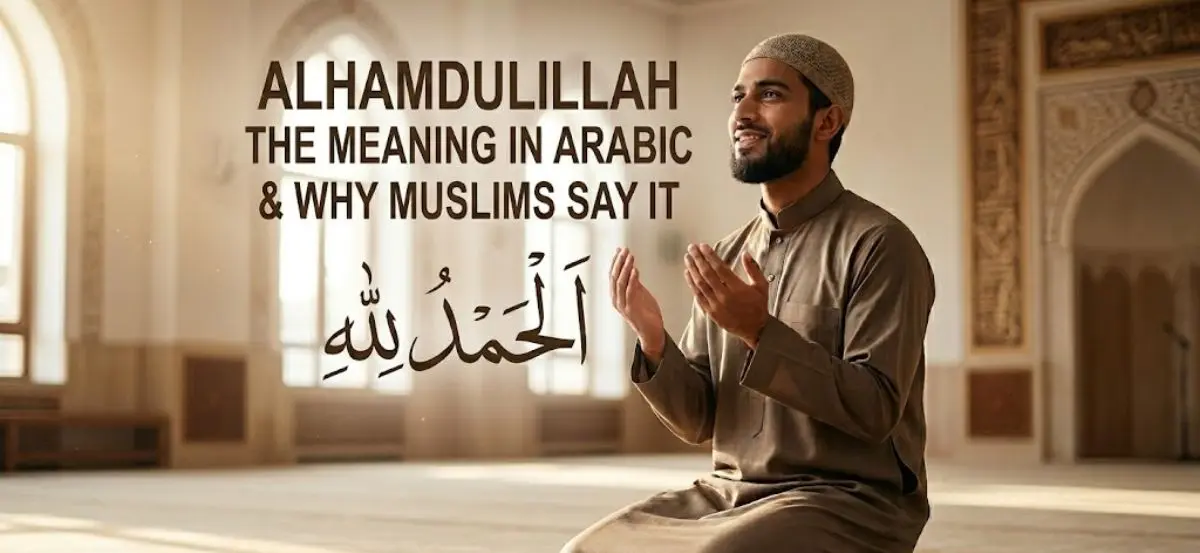
You’ve probably heard someone say alhamdulillah after good news, after a sneeze, or even after something painful — and wondered what it really means. It’s not just a word Muslims casually toss around. There’s something deeper behind it, something that makes people reach for it in their happiest moments and their hardest ones.
In this post, we’ll break down the alhamdulillah meaning in arabic — word by word, layer by layer — so you truly understand what you’re saying (or hearing). Whether you’re a Muslim wanting to connect more deeply with this phrase, or simply someone curious about its power, you’re in the right place. By the end, this little word will feel a whole lot bigger.
What Does Alhamdulillah Mean in Arabic?
At its core, alhamdulillah (الحمد لله) means “All praise is due to Allah.” It’s one of the most recognised phrases in the Islamic world, spoken by over 1.8 billion Muslims every single day — in happiness, in sorrow, after sneezing, and before sleeping. The full extended form, Alhamdulillahi Rabbil Alameen (الحمد لله رب العالمين), translates to “All praise is due to Allah, the Lord of the worlds” — and it opens Surah Al-Fatiha, the very first chapter of the Quran.
To really understand the alhamdulillah meaning in arabic, you need to break it into its three parts:
| Component | Arabic | Meaning |
| Al | ال | The — a definite article meaning “all, without exception” |
| Hamd | حمد | Praise and gratitude combined (rooted in H-M-D) |
| Lillah | لله | Belongs to Allah alone |
So it isn’t just “thanks” — it’s an acknowledgement that all praise, every form of it, belongs exclusively to Allah. That’s a powerful declaration packed into a single word.
Hamd vs Shukr — What’s the Difference?
Many people assume alhamdulillah simply means “thank you, God.” But Islamic scholars make an important distinction between two Arabic words: hamd (حمد) and shukr (شكر). Understanding this difference is what makes alhamdulillah truly extraordinary.
| Concept | Arabic Root | Meaning | When Used |
| Shukr | ش ك ر | Thanks for a specific favour received | Conditional — in response to a blessing |
| Hamd | ح م د | Unconditional praise — regardless of circumstances | Always — good times AND bad |
Hamd is praise you offer not because of what Allah gave you, but because of Who He is. This is why Muslims say alhamdulillah during hardship just as readily as during joy. It’s a declaration of iman (faith), sabr (patience), and tawakkul (trust in Allah) — all wrapped in one phrase.
Where Does Alhamdulillah Appear in the Quran?
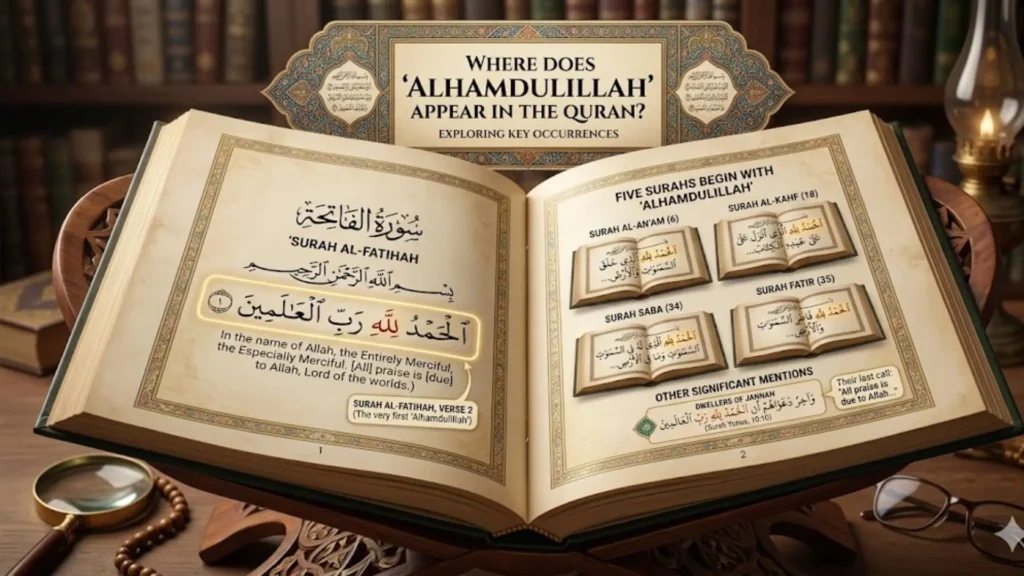
The word alhamdulillah appears in at least five distinct surahs — and remarkably, the Quran opens and closes with it, framing the entire revelation in praise of Allah. This makes it the most thematically bookmarked phrase in the entire Book.
- Surah Al-Fatiha (1:2) — “Alhamdulillahi Rabbil Alameen” — recited in every unit of every salah, at least 17 times daily
- Surah Al-An’am (6:1) — Praise of Allah who created the heavens and the earth
- Surah Al-Kahf (18:1) — Praise for the revelation of the Quran
- Surah Saba (34:1) — “Praise be to Allah, to Whom belongs all that is in the heavens and in the earth”
- Surah Fatir (35:1) — Praise of Allah as the Creator of angels
- Surah An-Nahl (16:114), Surah Ar-Rum (30:18) — Both carry the theme of tahmid (formal praise of Allah)
What Prophet Muhammad ﷺ Said About Alhamdulillah (Hadith)
The Prophet Muhammad ﷺ didn’t just teach Muslims to say alhamdulillah — he explained exactly how powerful it is. The hadiths on this phrase are striking in their depth and specificity.
“Purity is half of faith, and Alhamdulillah fills the scales (mizan).”
— Abu Malik Al-Ash’ari · Sahih Muslim
“The best supplication is Alhamdulillah.”
— Ibn Majah · classified as a dua, not just dhikr
After sneezing: Say alhamdulillah — those nearby respond Yarhamukallah (may Allah have mercy on you).
— Abu Salih hadith · direct Sunnah of the Prophet ﷺ
After each prayer (33 times): Subhanallah × 33, Alhamdulillah × 33, Allahu Akbar × 33 — described by the Prophet ﷺ as wiping away sins like foam on the sea.
— Sahih Muslim · post-salah morning and evening adhkar
Why Do Muslims Say Alhamdulillah?
If you’ve spent time around Muslims, you’ve noticed this word comes up constantly. That’s not an accident. Here are the seven core reasons:
- To thank Allah for blessings — health, food, family, safety. Every good thing is a gift from Allah, and alhamdulillah acknowledges that directly.
- During hardship — Saying alhamdulillah ‘ala kulli haal (“praise be to Allah in all circumstances”) expresses sabr and tawakkul even when life is painful.
- After sneezing — A direct Sunnah. It’s an act of worship, not just a social habit.
- After eating or drinking — Recognising that sustenance comes from Allah, Al-Rahman Al-Raheem.
- As part of daily Salah — Surah Al-Fatiha is recited at least 17 times a day across the five prayers.
- As dhikr (remembrance) — Saying it 33 times after each prayer is a specific Sunnah with documented spiritual rewards.
- Upon waking up and before sleeping — The Prophet ﷺ taught it as part of morning and evening adhkar that anchor the Muslim’s day.
When to Say Alhamdulillah — Complete Situations Guide
Not sure exactly when to use it? Here’s your practical reference for every situation:
| Situation | Arabic | What to Say |
|---|---|---|
| After sneezing | الحمد لله | Alhamdulillah |
| Someone asks “How are you?” | الحمد لله | Alhamdulillah (I’m well, praise Allah) |
| After eating or drinking | الحمد لله | Alhamdulillah |
| After completing a task | الحمد لله | Alhamdulillah |
| During hardship | الحمد لله على كل حال | Alhamdulillah ‘ala kulli haal |
| After each of the 5 prayers | الحمد لله × ٣٣ | Alhamdulillah (33 times) |
| Upon waking up | الحمد لله الذي أحيانا | Alhamdulillah alladhi ahyana |
| After good news | الحمد لله | Alhamdulillah |
Alhamdulillah vs Subhanallah vs MashAllah — What’s the Difference?
These three phrases come up together constantly, and many people — Muslims included — aren’t always sure which to use when. Here’s the definitive breakdown:
| Phrase | Arabic | Meaning | When to Use |
| Alhamdulillah | الحمد لله | All praise is due to Allah | Gratitude, blessings, hardship, sneezing |
| Subhanallah | سبحان الله | Glory be to Allah | Awe, amazement, beautiful things |
| MashAllah | ما شاء الله | Whatever Allah wills | Admiring something — wards off evil eye |
| Allahu Akbar | الله أكبر | Allah is the Greatest | Prayer, overcoming difficulty, awe |
| Bismillah | بسم الله | In the name of Allah | Before starting any action |
| Inshallah | إن شاء الله | If Allah wills | Future plans or hopes |
The key distinction: alhamdulillah is praise and gratitude, subhanallah is awe and glorification, and mashallah is an acknowledgement of Allah’s will. They’re often said together — subhanallah, alhamdulillah, Allahu Akbar — as a powerful triad of dhikr after salah.
Spiritual & Scientific Benefits of Saying Alhamdulillah
This is where it gets fascinating — because Islam and modern science actually agree on the power of gratitude.
Spiritual rewards
- Fills the scales (mizan) on the Day of Judgment — direct hadith from Sahih Muslim
- Surah Ibrahim (14:7): “If you are grateful, I will surely increase you in favour.” Saying alhamdulillah is that gratitude — and Allah promises increase in return.
- It is both dhikr (remembrance) and ibadah (act of worship). Every utterance earns reward.
Scientific research on gratitude
- Harvard Medical School research shows gratitude practices reduce cortisol (the stress hormone) and improve sleep quality.
- Positive psychology studies confirm that people who consciously express gratitude report lower anxiety and depression.
- This aligns with what researchers call “positive reappraisal” — reframing life through appreciation. Islam formalised this 1,400 years before psychology named it.
- The alhamdulillah mental health connection is real: saying it 33 times after every prayer, five times a day, is a built-in daily gratitude practice the Sunnah prescribed centuries ago.
Can Non-Muslims Say Alhamdulillah?
Alhamdulillah is an Arabic phrase — and Arabic is a language. Linguistically, anyone can say it. Many non-Muslims who live in Muslim-majority communities, study Arabic, or appreciate Islamic culture use it comfortably and respectfully. There is no Islamic ruling that prohibits a non-Muslim from saying it.
However, context matters. When a Muslim says alhamdulillah, it carries specific theological weight — a declaration that all praise belongs to Allah as described in the Quran. For a non-Muslim, saying it as a cultural appreciation or linguistic acknowledgement is different from saying it as a spiritual expression. Both are valid. The concept of gratitude to the Divine is universal. If the phrase resonates with you, there’s nothing wrong with letting it. What matters, ultimately, is sincerity.
How to Teach Children to Say Alhamdulillah
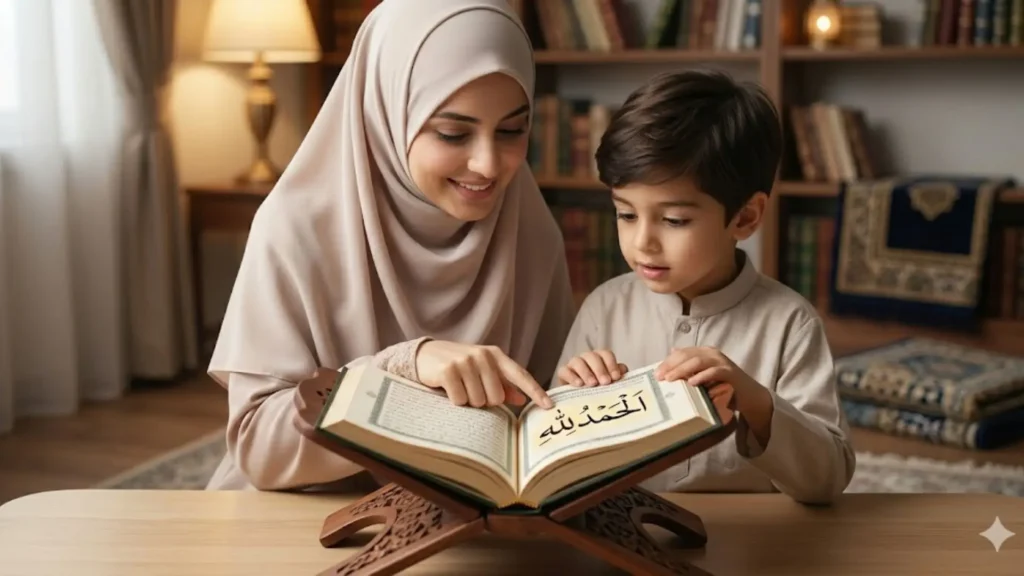
Kids learn best through repetition, stories, and emotion. The good news? Alhamdulillah is one of the easiest Islamic habits to build early — because it attaches to moments children already experience every single day.
- After eating: Make it a family rule — everyone says alhamdulillah before leaving the table. Children catch on within days.
- After sneezing: Teach them the exchange — they say alhamdulillah, you respond Yarhamukallah. Kids love having their own “special ritual.”
- When something good happens: Instead of just “yay!” teach them to follow it with alhamdulillah. Over time, they naturally connect good moments to gratitude to Allah.
- Storytime from Quran and Seerah: Share stories of the Prophet ﷺ saying alhamdulillah in difficult circumstances. Children understand emotion before theology — lead with the story.
- Morning routine: Teach the simple morning dua that begins with alhamdulillah. Even a two-year-old can mimic the sounds; meaning follows with time.
FAQs
What Is the Alhamdulillah Meaning in Arabic?
Alhamdulillah means “All praise belongs to Allah.” Muslims say it to thank Allah for every blessing and situation daily.
Why Do Muslims Say Alhamdulillah So Often?
Muslims say Alhamdulillah to express gratitude, happiness, relief, and faith in Allah during both good and difficult life moments.
When Should You Say Alhamdulillah in Daily Life?
You can say Alhamdulillah after eating, waking up, sneezing, succeeding, or whenever you feel thankful to Allah for blessings.
What Does Alhamdulillah Mean in Islam?
In Islam, Alhamdulillah means praising Allah sincerely for His mercy, kindness, guidance, and countless blessings given to humanity always.
Is Alhamdulillah Mentioned in the Quran?
Yes, Alhamdulillah appears in the Quran many times, especially in Surah Al-Fatihah, praising Allah as Lord of all worlds.
How Do You Pronounce Alhamdulillah Correctly?
Alhamdulillah is pronounced as “Al-ham-doo-lil-lah,” with soft pronunciation and respectful tone while praising Allah sincerely from the heart.
Why Is Understanding Alhamdulillah Meaning in Arabic Important?
Understanding Alhamdulillah Meaning in Arabic helps Muslims and non-Muslims appreciate gratitude, faith, and the spiritual beauty of Islamic expressions deeply.
Conclusion
The alhamdulillah meaning in arabic goes far beyond a two-second phrase. It’s a complete worldview — one that says all praise, in all circumstances, belongs to Allah alone. It’s hamd, not just shukr. It’s praise without condition, gratitude without limit, and trust without hesitation.
Whether you say it 33 times after Fajr, whisper it after a hard day, or teach it to your child at breakfast — every single utterance is an act of worship, a weight on the scales, and a reminder of where all good things truly come from.



Leave a Reply