We’ve all been there — you sit down to recite the Quran, start your prayer, or simply feel overwhelmed by dark thoughts, and somewhere in the back of your mind you remember you’re supposed to say something first. Something in Arabic. Something important. But you’re not quite sure what it means, why it matters, or whether you’re even saying it right. That small moment of uncertainty? It’s more common than you think.
In this post, we’ll break down Auzubillah Minashaitan Nirajeem completely — its meaning in English and Urdu, the Arabic text, when and why to say it, and what scholars across all four madhabs have said about it. Whether you’re a new Muslim or someone who’s been saying it for years without fully understanding it, you’ll walk away with real clarity and a deeper connection to these powerful words.
What Is Auzubillah Minashaitan Nirajeem?
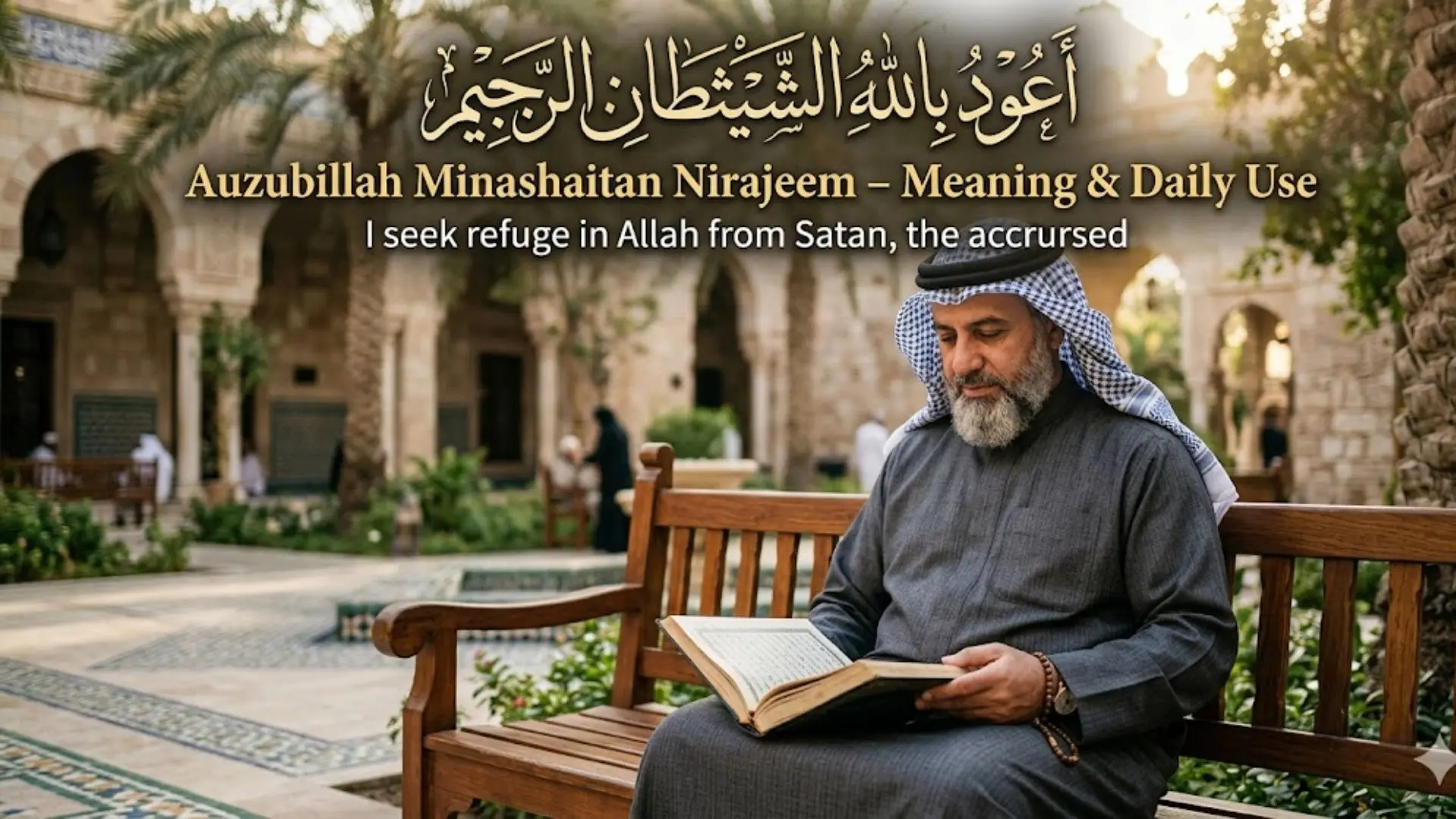
When you hear a scholar begin their Quran recitation, there’s always that soft, deliberate phrase that comes first — before a single verse, before even the Bismillah. That phrase is Auzubillah Minashaitan Nirajeem. In Arabic, it’s written as أَعُوذُ بِاللَّهِ مِنَ الشَّيْطَانِ الرَّجِيمِ, and its English meaning is: “I seek refuge in Allah from Satan, the accursed.” It’s not just a formality. It’s a declaration — a conscious act of turning to Allah for divine protection before engaging with His words.
In Islamic terminology, this phrase carries two closely related names: Ta’awwudh and Isti’adhah. Both refer to the act of seeking refuge in Allah from the accursed Shaytan. Scholars across all generations have recognised this supplication as one of the most powerful forms of Arabic Islamic dhikr a Muslim can make. Whether you’re beginning your Salah, opening the Quran, or simply feeling spiritually overwhelmed, this phrase is your first line of defence. It’s short, it’s profound and it connects you directly to Allah’s protection.
Word-by-Word Meaning (Arabic Breakdown)
Arabic is a language where every root carries weight. To truly understand Auzubillah Minashaitan Nirajeem, you need to look at each word individually — because the full power of this phrase only becomes clear when you understand what you’re actually saying. This isn’t just translation. It’s about knowing the intention, the niyyah, behind every syllable you utter.
Here’s the complete word-by-word breakdown:
| Arabic | Transliteration | Meaning |
| أَعُوذُ | A’udhu | I seek refuge / I take shelter |
| بِاللَّهِ | Billahi | In Allah (with Allah as my protector) |
| مِنَ | Mina | From |
| الشَّيْطَانِ | Ash-Shaytani | Satan / Shaytan (the whisperer, the enemy) |
| الرَّجِيمِ | Ar-Rajeem | The accursed / the expelled / the stoned |
The word Rajeem deserves a closer look. It comes from the Arabic root r-j-m, which means to stone or to expel. Iblis was cast out of Allah’s mercy after his disobedience — that’s exactly what Rajeem captures. He isn’t just evil; he’s permanently expelled from Allah’s grace. And the word A’udhu is active, not passive. You’re not asking someone else to protect you. You’re running toward Allah yourself, consciously choosing tawakkul — complete reliance on Him. That’s what makes this phrase so deeply personal and so spiritually alive.
Why Allah Commanded Us to Say This – Quranic Evidence
Allah doesn’t leave us guessing. In Surah An-Nahl 16:98, He gives a direct command: “So when you recite the Quran, seek refuge with Allah from Satan, the expelled.” This isn’t a suggestion from a scholar or a cultural habit passed down through generations. It’s a divine instruction — straight from the Quran itself. And when Allah commands something before His own words, that tells you everything about how seriously He takes our spiritual protection.
Ibn Kathir, in his famous tafsir, explains this verse by pointing out that Shaytan’s greatest target is the believer who opens the Quran. The moment you sit down to recite, your enemy gets to work — planting waswas, causing distraction, pulling your heart away from the words. Surah Al-Mu’minun 23:97-98 reinforces this beautifully, where Prophet Muhammad ﷺ was taught to say: “My Lord, I seek refuge with You from the incitements of the devils.” Allah knew the battle you’d face every time you opened His book. That’s exactly why He gave you this Quranic protection dua before you even begin.
The Story of Shaitan – Why We Need This Protection

Before you can truly appreciate this phrase, you need to understand who you’re seeking protection from. Iblis wasn’t always an outcast. He was among the most devoted of Allah’s creation — until the moment Allah commanded all beings to bow before Adam (AS). Iblis refused. His arrogance overrode his worship and that single act of disobedience earned him permanent expulsion from Allah’s mercy. He became Shaytan the expelled — Ar-Rajeem — exactly as the phrase describes him.
What makes Shaytan genuinely dangerous isn’t brute force. It’s patience and precision. After his expulsion, he made a sworn promise to Allah — recorded across multiple Quranic verses including Surah Al-Baqarah — that he would mislead the children of Adam from every direction. In front, behind, left and right. He specialises in waswas: those quiet, creeping whispers that make sin look reasonable and worship feel pointless. He attacks your niyyah before Salah, your focus during Quran recitation and your taqwa in moments of anger. Seeking refuge from Shaytan through this phrase isn’t dramatic — it’s simply the most rational response to a real, tireless enemy who has been at this since the beginning of humanity.
When Should You Say Auzubillah Minashaitan Nirajeem?
Most people only know this phrase as the Islamic supplication before Quran recitation — and while that’s its most well-known use, it goes far beyond that. The Prophet ﷺ and his companions used it across many situations in daily life. It wasn’t reserved for formal worship alone. It was a living, breathing part of how they navigated the world. That’s exactly how it should work for you too.
Here are the key moments when you should say it:
- Before reading the Quran — as directly commanded in Surah An-Nahl 16:98
- At the opening of Salah — before reciting Surah Al-Fatihah, as part of the salah opening dua
- When anger flares up — the Prophet ﷺ explicitly linked Shaytan to anger in Sahih al-Bukhari 6115, telling Sulaiman bin Surd to seek refuge from the accursed Satan
- When bad or intrusive thoughts strike — shield from waswas is one of the greatest gifts this phrase offers
- Before sleeping — paired with other evening adhkar for complete protection
- When feeling fear or anxiety — turning to Allah through this Muslim morning protection dua resets your spiritual footing
- When children are scared or having nightmares — teaching them to say it builds a habit of seeking Allah’s refuge early
- Before any important decision — clearing Shaytan’s influence before you think is always wise
The pattern here is clear. Anywhere Shaytan has an opening — anger, fear, distraction, temptation — this phrase closes it.
Hadith Evidence – Prophet ﷺ Ne Kab Farmaya?
The Quran commands it and the Prophet ﷺ lived it. Across multiple authentic hadith collections, we see exactly when and why the Messenger of Allah ﷺ directed his companions to seek refuge from Shaytan. These aren’t vague references — they’re specific moments, real situations, with named companions and precise guidance. That level of detail matters because it shows you this phrase wasn’t theoretical. It was practical, immediate and deeply human.
Three hadiths stand out above the rest. In Sahih al-Bukhari 6115, a companion named Sulaiman bin Surd witnessed two men arguing in the presence of the Prophet ﷺ. One man’s face had turned red with rage. The Prophet ﷺ didn’t raise his voice or intervene forcefully — he simply said: “I know a word that, if he said it, what he feels would go away: A’udhu billahi minash-shaytanir-rajeem.” Anger, in that moment, was identified as Shaytan’s work. Then in Sahih al-Bukhari 3282, Abu Qatadah narrated that bad dreams come from Shaytan — and the remedy is to seek refuge in Allah from him. Sunan Ibn Majah 3909 further confirms that this phrase shields a believer from distressing visions during sleep. Sunan Abi Dawud 4781 adds yet another layer, showing how the companions understood this supplication as a daily shield — not just a ritual phrase but a genuine act of tawakkul, of placing your complete reliance in Allah against a real enemy.
4 Madhab Ruling – Is It Obligatory or Sunnah?
Islamic jurisprudence doesn’t leave this question open-ended. All four major schools of thought — the Hanafi, Shafi’i, Hanbali and Maliki madhabs — have addressed the ruling on Ta’awwudh directly. Where they differ is in the details, not the principle. Every single madhab agrees that saying Auzubillah Minashaitan Nirajeem before Quran recitation is at the very minimum a confirmed sunnah — and that’s not a light designation. A confirmed sunnah means the Prophet ﷺ did it consistently and its abandonment is considered blameworthy.
Here’s how each madhab positions the ruling:
| Madhab | Ruling | Notes |
| Hanafi | Sunnah Mu’akkadah (confirmed sunnah) | Strongly recommended before Quran recitation and in Salah; not wajib but close |
| Shafi’i | Sunnah in Salah and outside it | Particularly emphasised before the first rak’ah; some Shafi’i scholars consider it obligatory within Salah |
| Hanbali | Sunnah Mu’akkadah | Required before recitation in Salah; to be said silently in congregational prayer |
| Maliki | Sunnah outside Salah only | The Maliki position is unique — Ta’awwudh is not recommended inside Salah itself but is encouraged before independent Quran recitation |
What’s striking here isn’t the differences — it’s the agreement. No madhab dismisses this phrase. No scholar across fourteen centuries of Islamic scholarship has called it unnecessary. The Isti’adhah in Islam carries genuine legal and spiritual weight, and understanding that weight is what separates someone who says it out of habit from someone who says it with full conviction and taqwa.
Spiritual & Mental Benefits of Saying This Phrase
There’s a reason Allah commanded this phrase specifically before His own words. Protection from evil in Islam isn’t just a spiritual concept — it has real, tangible effects on how you think, feel and act. When you say Auzubillah Minashaitan Nirajeem with genuine awareness, you’re not just reciting syllables. You’re making a conscious choice to orient yourself toward Allah before anything else. That shift in orientation changes everything that follows.
The benefits work on multiple levels at once. Spiritually, it creates an immediate barrier between you and Shaytan’s influence — particularly his waswas, those intrusive whispers that derail your focus during Salah or cloud your judgement in daily life. The Prophet ﷺ directly linked this phrase to anger management in Sahih al-Bukhari, which means it isn’t just spiritual wisdom — it’s practically backed by prophetic guidance. Mentally, saying it before prayer or Quran recitation builds taqwa over time. Every time you pause, acknowledge Shaytan’s threat and consciously seek Allah’s refuge, you’re training your niyyah — sharpening your intention before worship. Ibn Kathir noted that the believer who approaches the Quran with Isti’adhah enters it with a protected heart. And a protected heart absorbs more, understands deeper and connects stronger. That’s not a small thing. That’s the entire point of recitation.
Common Mistakes People Make
Most Muslims grow up hearing this phrase so often that it becomes automatic — and that’s exactly where the problem starts. Automaticity is the enemy of awareness. When something becomes purely habitual, the meaning quietly drains out of it. You’re still saying the words but you’ve stopped meaning them. And a phrase this powerful deserves better than that.
Here are the most common mistakes Muslims make with this supplication — and why each one matters:
- Saying it without understanding — If you don’t know that A’udhu means “I am actively running to Allah for shelter,” you’re missing the entire emotional weight of what you’re saying. Understanding transforms recitation into intention.
- Only saying it before the Quran — As the hadiths in Sahih al-Bukhari and Sunan Abi Dawud 4781 show, this phrase belongs in moments of anger, fear, bad dreams and daily decisions — not just formal recitation.
- Forgetting it in moments of anger — This is arguably the costliest mistake. The Prophet ﷺ specifically prescribed this phrase for anger in Sahih al-Bukhari 6115 because that’s precisely when Shaytan is most active. Most people reach for a reaction instead of this refuge.
- Rushing through it without niyyah — Saying it in half a second before Salah without pausing to set your intention defeats its spiritual purpose entirely. Tawakkul requires conscious surrender — not speed.
- Mispronouncing key words — Saying “Astaghfirullah” instead when flustered, or blending Ash-Shaytani and Ar-Rajeem into an unrecognisable blur, weakens both the Tajweed and the mindfulness behind it.
Recognising these mistakes isn’t about guilt. It’s about upgrading a phrase you already say into something that genuinely shields you every single time.
How to Teach This to Children
Children don’t need theology — they need stories, safety and repetition. The beautiful thing about this phrase is that it speaks directly to what children already feel: fear of the dark, bad dreams, scary thoughts they can’t explain. You don’t need to start with Quranic references or madhab rulings. You start with what they know and what they feel, and you build from there.
Here’s a simple, age-appropriate approach that actually works:
- Start with nightmares — When a child wakes up frightened, that’s your most natural teaching moment. Hold them close, say the phrase slowly together and explain it simply: “These are the words that tell Shaytan to go away. Allah hears you every time you say them.” That connection between fear and divine protection Islam offers is something children grasp immediately and remember deeply.
- Make it part of the bedtime routine — Pair it with Surah Al-Fatihah and the three Quls every night. Consistency builds habit and habit builds belief. Children who grow up saying this phrase before sleep carry it instinctively into adulthood.
- Use the story of Iblis — Keep it age-appropriate, but children are naturally drawn to the story of how Iblis refused to bow and was expelled. It makes Ar-Rajeem real for them — not an abstract word but a character they understand as the one who was sent away from Allah’s mercy.
- Praise the effort, not the perfection — A child who says it imperfectly with full heart is doing better than an adult who says it perfectly without thought. Encourage the niyyah first and Tajweed will follow naturally with time.
The goal isn’t to make children fear Shaytan. It’s to make them love running to Allah — and this phrase is one of the earliest and most beautiful ways to teach them exactly that.
Auzubillah vs Bismillah – What’s the Difference?

If you’ve ever wondered why you say one before the other — or whether you even need both — you’re asking exactly the right question. These two phrases are deeply connected but they serve entirely different purposes. Confusing them or collapsing them into one habit means you’re shortchanging what each one actually does for you spiritually and practically.
Think of it this way: Auzubillah Minashaitan Nirajeem is the shield and Bismillah is the key. The Ta’awwudh — seeking refuge from Shaytan — clears the path. It removes the obstacle, the interference, the enemy standing between you and what you’re about to do. The Basmala then opens the door — you begin in Allah’s name, with His blessing, with His presence acknowledged at the start of your action. The sequence matters enormously. Surah An-Nahl 16:98 commands the Ta’awwudh before Quran recitation specifically because you need the protection before you need the blessing. Shaytan must be addressed first. Then Allah’s name opens everything. Surah At-Tawbah is the only surah in the Quran that doesn’t begin with the Basmala — and scholars note this is precisely because it opens with a declaration of disavowal, not an invitation. That single exception across 114 surahs shows just how deliberate and meaningful the basmala sequence truly is across the rest of the Quran.
FAQs
What Does Auzubillah Minashaitan Nirajeem Mean in English?
It means “I seek refuge in Allah from Satan, the accursed.” It’s a powerful Islamic protection phrase said daily.
When Should I Say Auzubillah Minashaitan Nirajeem?
Say it before reading the Quran, during anger, before sleep, in fear, and whenever Shaytan’s whispers feel strong.
Is Auzubillah Minashaitan Nirajeem Actually in the Quran?
Yes. Allah commands it directly in Surah An-Nahl 16:98 before Quran recitation. It’s a divine instruction, not just tradition.
What Is the Arabic Text of Auzubillah Minashaitan Nirajeem?
The full Arabic text is: أَعُوذُ بِاللَّهِ مِنَ الشَّيْطَانِ الرَّجِيمِ. Recite it clearly with proper Tajweed for full spiritual benefit.
What Is the Difference Between Auzubillah and Bismillah?
Auzubillah seeks refuge from Shaytan first. Bismillah then begins with Allah’s name. One is the shield, one the key.
What Does Ta’awwudh Mean in Islam?
Ta’awwudh means seeking refuge in Allah from Shaytan. It’s the Islamic term for this specific supplication before Quran recitation.
Can I Say Auzubillah Minashaitan Nirajeem When I Feel Angry?
Absolutely. The Prophet ﷺ prescribed it specifically for anger in Sahih al-Bukhari 6115. It’s Shaytan’s most active moment.
Conclusion
Auzubillah Minashaitan Nirajeem isn’t just a phrase you say before the Quran. It’s a shield, a declaration and a daily act of tawakkul — placing your complete trust in Allah against an enemy who never rests. Every time you say it with awareness, you’re choosing Allah’s protection over Shaytan’s interference. That’s not a small thing. That’s taqwa in action.
So don’t let it stay on autopilot. Say it before your Salah, in your anger, at bedtime and whenever doubt creeps in. Teach it to your children. Mean it every single time. The Prophet ﷺ gave it to us for every moment life gets hard — and life will always get hard. This phrase is your answer.





Leave a Reply