Someone holds the door for you at the masjid, helps you carry groceries after Jumu’ah, or sends you a heartfelt message when you needed it most — and the only thing that feels right to say is Jazakallah Khair. It comes out almost automatically. But do you actually know what you’re saying, or why the Prophet ﷺ called it the highest form of praise?
Most people know it means something like “thank you” in Islam. What they don’t know is why saying just Jazakallah — without the word Khair — is grammatically problematic, how the phrase changes depending on who you’re speaking to, and what the correct reply actually is. In 2026, as more Muslims in the US are reconnecting with Arabic phrases and their origins, understanding this expression fully has become more relevant than ever.
This guide covers the exact Arabic meaning of Jazakallah Khair, its word-by-word breakdown, the hadith behind it, gender forms, common mistakes, and how to respond properly — everything in one place.
What Jazakallah Khair Means in Arabic
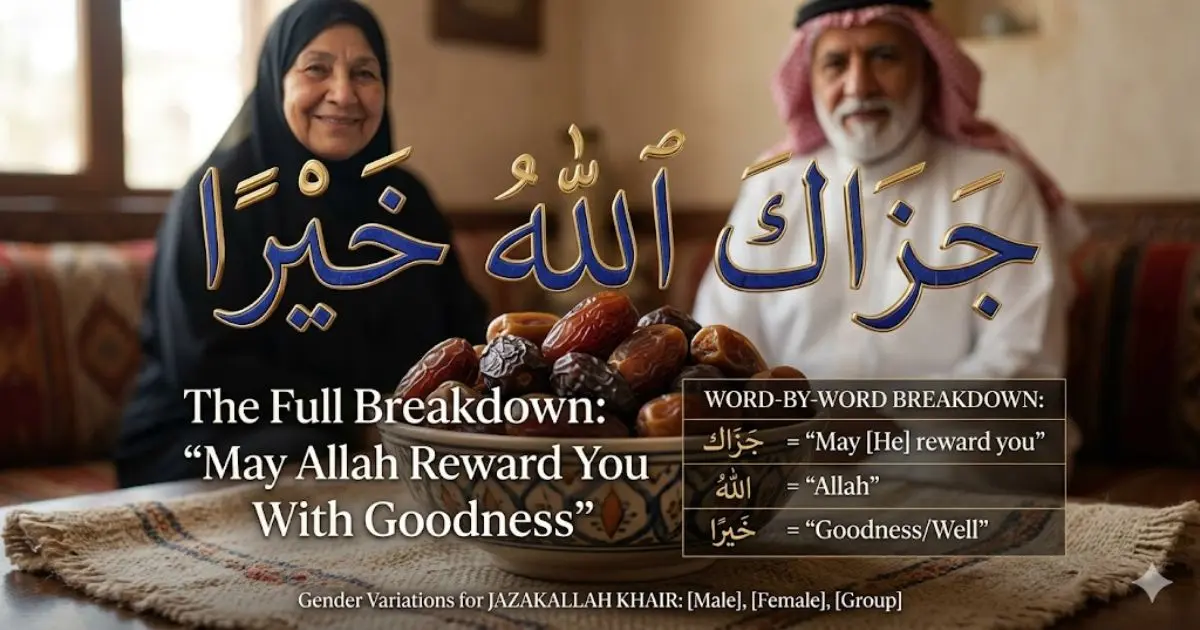
Jazakallah Khair (جَزَاكَ اللهُ خَيْرًا) means “May Allah reward you with goodness.” It’s a dua — a supplication — directed at a person who has done something kind or helpful for you. It doesn’t just express appreciation; it redirects that gratitude toward Allah, asking Him to reward the person in ways no human being ever could.
The phrase appears frequently in authentic hadith and reflects one of Islam’s core values: that goodness should be acknowledged, and that real gratitude goes beyond words.
Word-by-Word Arabic Breakdown
Breaking it down makes it clearer and far easier to remember:
| Arabic | Transliteration | Meaning |
| جَزَا | Jazā | To reward / recompense |
| كَ | ka | You (masculine singular) |
| اللهُ | Allāhu | Allah (He who rewards) |
| خَيْرًا | Khayran | With goodness / with the best |
So the full sentence — Jazaka Allahu Khayran — literally reads: “May Allah reward you with goodness.” The verb jazā comes from the Arabic root ج-ز-ي (j-z-y), meaning to repay or recompense. The suffix -ka specifies who is being addressed: a single male. That suffix shifts depending on gender and number, which we’ll cover next.
Why “Jazakallah” Alone Is Incomplete
This is probably the most overlooked point in every article on this topic, and it’s worth understanding properly.
The Arabic verb jazā doesn’t specify whether the reward is good or bad. It simply means “to recompense.” So saying Jazakallah on its own — without Khair — technically means “May Allah recompense you,” which could be reward or punishment depending on context. The meaning is grammatically ambiguous.
Adding Khayran (خَيْرًا) removes all ambiguity. It specifies the reward as goodness. That’s exactly the phrase the Prophet ﷺ taught — always the complete form.
In my experience helping friends learn Arabic phrases, this is the single correction that surprises people most. They’ve been saying a shorter version their whole lives without realising the full version carries an entirely different weight.
“Whoever says Jazakallahu Khairan to a person who has done him good has praised him exceedingly.” — Jami’ at-Tirmidhi 2035, authenticated by Al-Albani
The Hadith That Makes This Phrase Sunnah
The direct source for this expression is a hadith narrated by Usamah ibn Zayd (رضي الله عنه), recorded in Jami’ at-Tirmidhi 2035. The Prophet ﷺ said:
“Whoever has a favor done for him and says to the one who did it ‘Jazak Allahu Khairan,’ has indeed praised him greatly.”
This hadith tells us two things. First, this is the prophetic response to receiving a favor — it’s Sunnah, not just custom. Second, the Prophet ﷺ framed it as great praise. The reasoning is theologically sound: when you say Jazakallah Khair, you’re acknowledging that the best reward this person could ever receive is from Allah — not from you, not from the world. It’s humble, it’s sincere, and it carries a dua for the other person.
According to Islamic teachings documented in Sahih Ibn Hibban 3413, this phrase is considered one of the most generous things you can say to someone, precisely because you’re directing your thanks toward the Most Generous.
Gender Forms: Jazakallah vs. Jazakillah vs. Jazakumullah
Arabic is a gendered language, and the phrase changes based on who you’re speaking to. Most English-speaking Muslims use the masculine singular form for everyone — which isn’t wrong in casual use, but using the correct form shows both linguistic knowledge and respect.
| Recipient | Arabic | Transliteration | Meaning |
| Single male | جَزَاكَ اللهُ خَيْرًا | Jazakallahu Khairan | May Allah reward you (m) with goodness |
| Single female | جَزَاكِ اللهُ خَيْرًا | Jazakillahu Khairan | May Allah reward you (f) with goodness |
| Group / plural | جَزَاكُمُ اللهُ خَيْرًا | Jazakumullahu Khairan | May Allah reward you all with goodness |
The only difference between male and female is the suffix: -ka for male, -ki for female. If you listen closely, native Arabic speakers adjust this naturally in conversation. Non-native speakers who learn this distinction are usually appreciated for the effort, especially in Arabic-speaking communities.
Explore our guide toBarakallahu Feek meaningfor the full picture of Islamic gratitude expressions.
How to Reply to Jazakallah Khair
A lot of people say “Jazakallah Khair” back in response, which isn’t incorrect — but there are more precise replies rooted in Sunnah.
Wa Iyyak (وَإِيَّاكَ) — “And to you also” (for a male)
Wa Iyyaki (وَإِيَّاكِ) — “And to you also” (for a female)
Wa Iyyakum (وَإِيَّاكُمْ) — “And to you all” (for a group)
Another common reply is Barakallahu Feek (بَارَكَ اللهُ فِيكَ), meaning “May Allah bless you” — this is warm, widely used, and entirely appropriate.
But here’s the thing: Wa Iyyak is actually the more precise Sunnah reply. It mirrors the original dua back to the speaker, essentially saying “the same reward I just asked for you — I ask for you in return.” It’s reciprocal gratitude at its most elegant.
Jazakallah Khair vs. Shukran vs. Barakallahu Feek
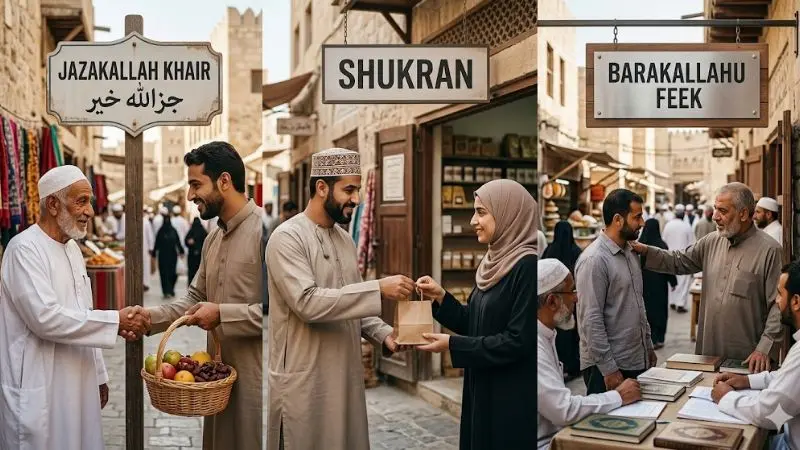
People sometimes wonder whether these phrases are interchangeable. They’re not — each carries a different register and theological weight.
| Expression | Meaning | Nature |
| Shukran (شُكْرًا) | Thank you | Simple human thanks, secular |
| Jazakallah Khair | May Allah reward you with goodness | Dua — requests divine reward |
| Barakallahu Feek | May Allah bless you | Dua — requests Allah’s blessings |
| Jazakumullahu Khairan | May Allah reward you all | Same as Jazakallah Khair, plural |
Shukran is fine in any context — it’s neutral. But using Jazakallah Khair specifically in response to someone’s kindness carries a spiritual dimension that Shukran doesn’t. You’re not just acknowledging what they did; you’re making dua for them. And a dua, by its nature, costs you nothing but benefits them potentially in ways the world can’t measure.
Some people argue that Shukran is sufficient, or that using Arabic phrases you don’t fully understand can feel hollow. That’s a fair point. But from our research into how American Muslim communities actually use this phrase — in masjid settings, Islamic schools, and everyday conversations — the consensus is clear: Jazakallah Khair said with genuine understanding carries more barakah than Shukran said from habit.
Common Mistakes People Make
Saying “Jazakallah” without “Khair.” As covered above, this leaves the meaning incomplete and potentially ambiguous.
Using the wrong gender form. Saying Jazaka (masculine) to a woman, or Jazaki (feminine) to a man, is a grammatical error — even if the intent is right.
Pronouncing it as “Jazakalah” or “Jazakullah.” The correct pronunciation separates clearly: ja-za-KA al-LA-hu KHAY-ran. The word “Allah” in the middle should not be slurred into ullah with the preceding syllable.
Treating it as a filler phrase. When someone says it reflexively after every small interaction — like a verbal tic — the sincerity drains out of it. The Prophet ﷺ praised it as high praise. Keeping that weight in mind when you say it matters.
When to Use It in Daily Life
This phrase fits any moment someone does something genuinely kind or helpful — big or small. A teacher who explains a difficult concept, a friend who covers for you at work, someone who shares beneficial knowledge, a neighbor who helps you move boxes. Jazakallah Khair works in all of those situations.
It also appears frequently in written communication — ending an email to an Islamic teacher, thanking someone on a Muslim forum, closing a message to a community member who helped organize an event. In the US, Muslims in cities like Dearborn, Houston, and New York often use it naturally in everyday speech, and non-Muslim friends and coworkers who hear it often find it a beautiful expression when its meaning is explained.
One thing worth noting: Jazakallah Khair is traditionally said person-to-person — to someone who helped you specifically. It’s not typically used as a general blessing to a crowd the way Barakallahu Feek sometimes is.
FAQ
What does Jazakallah Khair mean?
Jazakallah Khair (جَزَاكَ اللهُ خَيْرًا) means “May Allah reward you with goodness.” It’s a dua used by Muslims to express sincere gratitude for a kindness received.
How do you reply to Jazakallah Khair?
Say Wa Iyyak (وَإِيَّاكَ) — “And to you also.” For a female, say Wa Iyyaki. Barakallahu Feek is also a widely accepted reply.
Is it Jazakallah or Jazakallah Khair?
The complete and correct form is Jazakallah Khair. Saying just “Jazakallah” without “Khair” leaves the meaning ambiguous — the Arabic verb jaza can imply either reward or punishment.
What is the difference between Jazakallah and Jazakillah?
Jazakallah is for a male; Jazakillah is for a female. The only difference is the suffix: -ka for male, -ki for female.
When should you say Jazakallah Khair?
When someone does you a genuine favor — helping you, sharing useful knowledge, or showing kindness. It works in both spoken and written communication.
Is Jazakallah Khair in the Quran?
The exact phrase isn’t in the Quran, but the concept of divine reward for goodness is throughout Islamic scripture (Quran 76:22, 55:60). Its primary source is Jami’ at-Tirmidhi 2035.
What does Wa Iyyak mean?
Wa Iyyak (وَإِيَّاكَ) means “And to you also.” It’s the Sunnah reply to Jazakallah Khair, returning the same dua back to the person who said it.
Conclusion
Jazakallah Khair meaning in Arabic is more than a polite phrase — it’s a prophetically endorsed dua that turns a moment of gratitude into an act of worship. The next time someone does you a genuine kindness, try saying the full Jazakallahu Khairan, matching the gender correctly, and meaning it. That’s the Sunnah way — and it carries more weight than any thank-you card ever could.
If you want to go deeper, explore our article on Barakallahu Feek meaning to understand the full landscape of Islamic gratitude expression



Leave a Reply