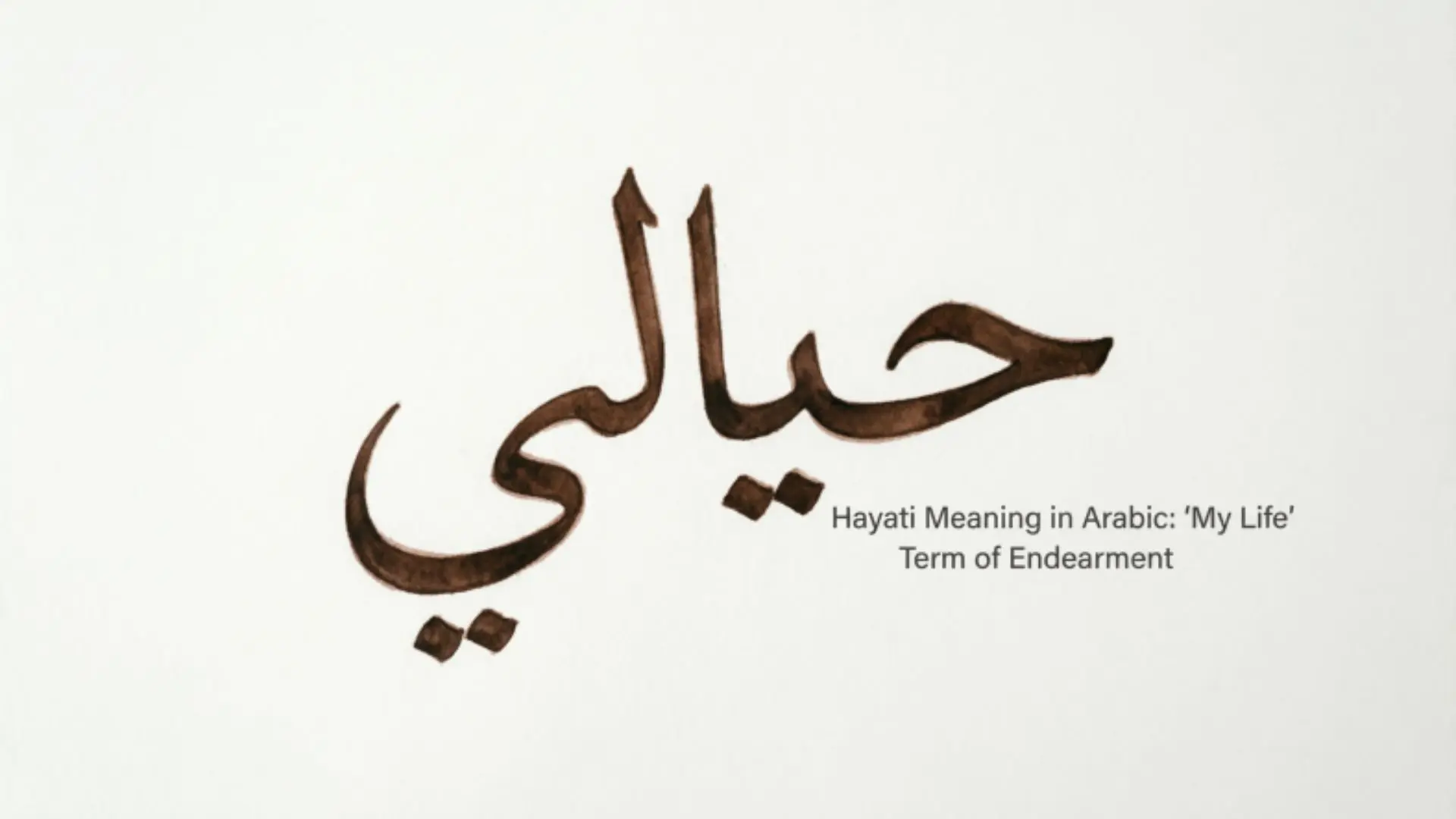
Have you ever heard someone say hayati in an Arabic song, a drama, or a TikTok video — and felt something, even without knowing what it meant? That’s the power of this word. It doesn’t just translate; it hits differently. And if you’ve been searching for what it actually means, you’re exactly where you need to be.
Here’s the quick answer: Hayati (حياتي) means “My Life” in Arabic. You pronounce it simply as ha-yaa-tee. But honestly, the translation alone doesn’t do it justice. In this article, you’ll learn the full hayati meaning — where it comes from, how to say it correctly, who you can use it with, how it differs from habibi, and why this beautiful word runs so deep in Arabic culture and everyday life. Stick around — it’s more interesting than you’d expect.
Hayati Meaning in Arabic — The Direct Answer
The word hayati (حياتي) directly translates to “My Life” in English. But to an Arabic speaker, it means far more than that. When someone calls you hayati, they’re not just saying you’re important to them — they’re saying you are their existence. It’s the kind of word that carries weight, warmth, and a depth that simple translations often miss.
Here’s a quick breakdown of the most common forms you’ll hear:
| Arabic | Transliteration | English |
| حياتي | Hayati | My Life |
| يا حياتي | Ya Hayati | Oh My Life |
| أنت حياتي | Anta/Anti Hayati | You Are My Life |
Think of it this way — in Urdu, we say “tu meri jaan hai.” In Arabic, hayati carries that exact same feeling, maybe even heavier. It doesn’t just mean “my life” in a poetic, casual way. It means “you are my wajood — my very being.” When an Arabic mother whispers ya hayati to her child, or a husband says it to his wife after years together, it’s not a compliment. It’s a confession of how deeply someone is woven into your world.
How to Pronounce Hayati — Step by Step
Most people hear hayati in a song and immediately try to repeat it — and most people get it slightly wrong. Don’t worry, it’s an easy fix. The word has three syllables, and once you break it down, it flows naturally. Here’s exactly how to say it:
| Syllable | Sound | How to Say It |
| ha | حـ | From the throat — soft but breathy, like a gentle “ha” |
| yaa | يا | Stretch it slightly — like a slow, smooth “yaa” |
| tee | تي | Soft T at the end — not sharp, not hard |
Put it together: ha-yaa-tee. Say it slowly first, then let it roll naturally.
Now, here are the mistakes almost everyone makes — and how to avoid them:
- ❌ hay-ti — too rushed, drops the middle syllable completely
- ❌ hi-ya-tee — wrong vowel at the start, sounds off to native ears
- ✅ ha-yaa-tee — this is correct, clean, and natural
The best way to lock in the pronunciation? Listen to it in context. Watch an Arabic drama or pull up a song that uses hayati — your ear will catch the rhythm fast. Ali Gatie’s song “Hayati” is a great starting point. You’ll hear it said the right way, in the right tone, and it’ll stick with you far better than any phonetic guide ever could.
Arabic Root & Grammar — Why It Means “My Life”
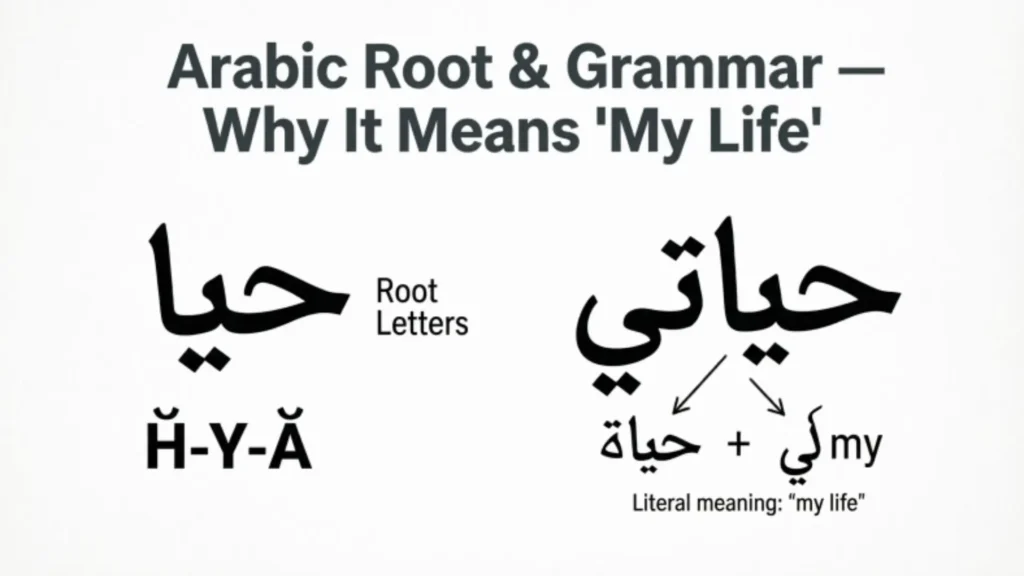
Arabic is a root-based language — and once you understand how it works, words start making beautiful sense. The word hayati comes from the three root letters ح-ي-و (H-Y-W), which carry the core meaning of life, living, and existence. Almost every word built from these three letters connects back to that same idea. The base word here is حياة (Hayah), which simply means “life.” Now here’s where the grammar gets interesting — and honestly, quite elegant.
In Arabic, you add a simple suffix “-i” to the end of a noun to mean “my.” So when you attach “-i” to Hayah, something small but powerful happens:
حياة (Hayah) + ي (-i) = حياتي (Hayati) = “My Life”
That’s it. One letter. And yet it transforms a general word into something deeply personal. Here’s a table of related words that all grow from the same root — you’ll notice the family resemblance immediately:
| Word | Meaning |
| حياة (Hayah) | Life |
| حي (Hayy) | Living / Alive |
| حياتي (Hayati) | My Life |
| حياتك (Hayatak) | Your Life |
This is why Arabic feels so rich and layered. One root — three letters — and an entire family of meaningful words blooms from it. When you say hayati, you’re not just using a term of endearment. You’re drawing from a deep linguistic well that connects life, love, and belonging all in one breath.
Who Can You Say Hayati To?
Hayati is a word with real emotional weight — and that means context matters. You can’t just drop it casually with anyone. In Arabic culture, this word is reserved for people who genuinely hold a special place in your heart. Most people assume it’s purely romantic but that’s actually one of the most common misconceptions. Parents say ya hayati to their children all the time — it’s one of the most natural and tender things a mother can say. Close siblings, lifelong best friends, and deeply bonded relationships all qualify too.
Here’s a simple guide so you always use it in the right situation:
| ✅ Use Hayati With | ❌ Avoid Hayati With |
| Romantic partner (spouse / boyfriend / girlfriend) | Strangers or acquaintances |
| Your children — deeply natural in Arabic families | Professional or workplace settings |
| A very close best friend | Formal situations |
| Siblings (with genuine deep affection) | Someone you’ve just met |
Now here’s something people often wonder about — does the word change based on gender? The short answer is no. Hayati itself stays exactly the same. Only the pronoun in front of it shifts slightly:
| Saying It To | Form Used |
| Male (Anta) | أنت حياتي |
| Female (Anti) | أنتِ حياتي |
The difference is subtle — just a small change in the pronoun, not the word itself. So whether you’re saying it to a man or a woman, hayati remains hayati. Simple, clean, and beautifully consistent.
Hayati vs Habibi — What’s the Difference?
If you’ve spent any time around Arabic music or culture, you’ve definitely heard habibi too. Most people assume hayati and habibi mean the same thing — they don’t. They’re both terms of endearment but they sit at very different levels of emotional depth. Habibi (حبيبي) means “my beloved” or “my love” — and honestly, Arabs use it pretty freely. You’ll hear friends say it to each other, shopkeepers use it with customers, even strangers drop it casually in conversation. Hayati, on the other hand, isn’t thrown around like that. It carries a heavier, more intimate weight — reserved only for people who are truly central to your life.
Here’s a side-by-side breakdown so the difference is crystal clear:
| Hayati (حياتي) | Habibi (حبيبي) | |
|---|---|---|
| Meaning | My Life | My Beloved / My Love |
| Intensity | 🔥🔥🔥🔥🔥 Very Deep | 🔥🔥🔥 Moderate |
| Usage | Close relationships only | Can use casually too |
| Context | Romantic, family | Friends, strangers even |
But here’s something no other site actually shows you — Arabic terms of endearment follow a real emotional intensity scale. It’s not just hayati vs habibi. There’s a whole spectrum, and understanding it gives you a much deeper feel for how Arabs express love and connection:
💛 Habibi → Albi → Hayati → Roohi → Omri (Least Intense → Most Intense)
Habibi is warm and common. Albi (my heart) steps it up. Hayati (my life) goes deeper still. Roohi (my soul) is profoundly intimate. And Omri (my life’s length / my whole life) — that one is reserved for the deepest bonds imaginable. So when someone calls you hayati, understand that they’re not being casual. They’re placing you well above everyday affection — and that’s a beautiful thing.
Real Conversation Examples
Knowing what hayati means is one thing — hearing it used naturally is another. That’s what makes it click. Here are three real-life scenarios showing exactly how Arabs use this word in everyday moments. You’ll notice it doesn’t always sound dramatic. Sometimes it’s as simple and warm as calling someone for lunch.
Example 1 — Between a Couple
- 🗣️ Ahmed: “Ya hayati, akharek wein?”
- 🗣️ Sara: “Jeet, habibi”
- 📝 Translation: “My life, where have you been?” / “Here, my love”
- ✅ Natural, affectionate, used without overthinking it
Example 2 — Mother to Child
- 🗣️ Mama: “Ta’al ya hayati, el-ghada jaahez”
- 📝 Translation: “Come, my life, lunch is ready”
- ✅ Warm, everyday parenting — not romantic at all
- ✅ Shows hayati isn’t just for couples
Example 3 — Text Message Style
- Arabs often type it casually in chats — no formality needed
- Common texting forms you’ll actually see:
| Text Style | Meaning |
| ya hayati 🤍 | Oh my life |
| anta hayati | You are my life (to male) |
| anti hayati | You are my life (to female) |
| hayati killo | My whole life |
Hayati in Arabic Songs & Poetry
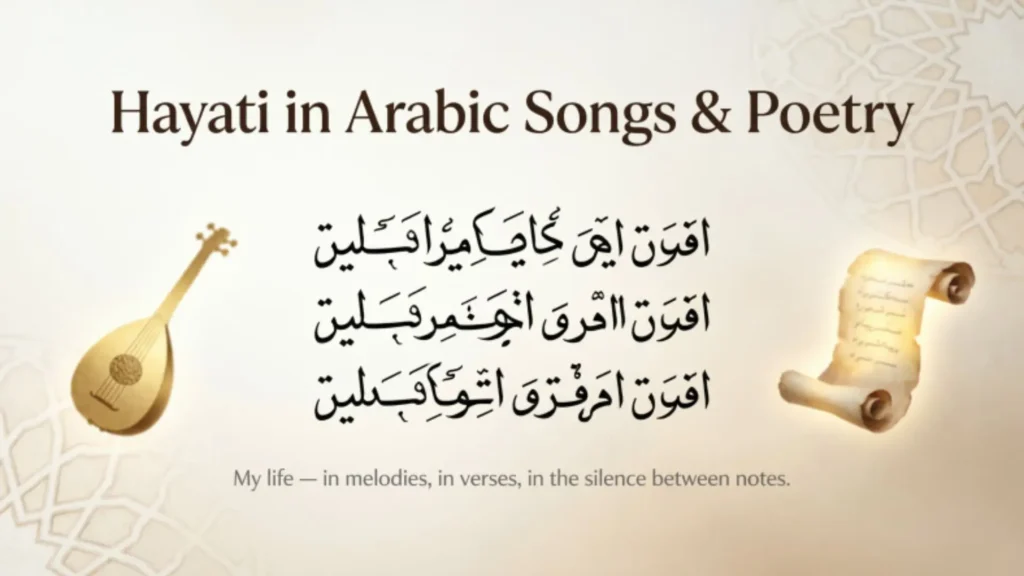
If you first heard hayati in a song or a TikTok video — you’re not alone. Music is honestly the biggest reason this word went global. Arabic artists have used hayati for decades, but it’s only recently that the rest of the world started paying attention. Ali Gatie’s song “Hayati” is probably the most direct reason you’re reading this right now. The Canadian-Iraqi artist wrote it as a raw, emotional love letter — and the moment it hit TikTok, millions of people who had never spoken a word of Arabic were suddenly searching “what does hayati mean?” That’s the power of music crossing language barriers effortlessly.
But hayati didn’t start with TikTok — not even close. Long before streaming existed, the legendary Egyptian singer Umm Kulthum wove words like hayati into her classical Arabic songs with such depth that audiences would weep mid-performance. She shaped how an entire generation emotionally connected with Arabic terms of endearment. And then there’s Nizar Qabbani — one of the greatest Arab poets of the 20th century — who used hayati in his poetry the way a painter uses the most precious colour on the canvas. Sparingly, deliberately, and always with devastating impact. Here’s a look at how hayati has lived across different musical and poetic worlds:
| Artist / Figure | Medium | How They Used Hayati |
| Ali Gatie | Modern Pop / TikTok | Romantic song — made the word go viral globally |
| Umm Kulthum | Classical Arabic Music | Emotional ballads — deep cultural weight |
| Nizar Qabbani | Poetry | Used to express total devotion and longing |
| Arabic Drama OSTs | TV / Streaming | Appears constantly in emotional scenes |
What makes hayati so perfect for music and poetry is its sound as much as its meaning. It’s soft, it flows, and it lands with quiet intensity. You don’t need to understand Arabic to feel it when a singer says it. That emotional universality — the sense that someone is calling another person their entire world — is exactly why this word travels so well across cultures, languages, and For You Pages.
Regional Dialect Differences
One of the most fascinating things about Arabic is that it isn’t one single language — it’s a family of dialects, each with its own personality, rhythm, and emotional texture. The good news is that hayati travels well across almost all of them. You’ll hear it from Cairo to Casablanca, from Beirut to Dubai. However, how often it’s used, and the emotional tone behind it, does shift depending on the region. Some dialects lean into it heavily while others use it more sparingly — but the meaning and the warmth behind it never really change.
Here’s a detailed regional breakdown you won’t find properly covered anywhere else:
| Region | How They Use It | Emotional Frequency | Example |
| Egyptian Arabic | Very common, highly emotional — Egyptians are expressive and use it freely | 🔥🔥🔥🔥🔥 Very High | يا حياتي |
| Levantine (Syria / Lebanon) | Common and natural — flows easily in everyday affectionate speech | 🔥🔥🔥🔥 High | يا حياتي |
| Gulf Arabic | Used but noticeably less frequent — Gulf speakers tend to be more reserved in expression | 🔥🔥🔥 Moderate | حياتي |
| Moroccan / Maghrebi | Hayati appears but often mixes with Darija (Moroccan dialect) words and expressions | 🔥🔥🔥 Moderate | حياتي |
What’s interesting is that Egyptian Arabic arguably gave hayati its biggest cultural platform — largely because Egyptian cinema and music dominated the Arab world for most of the 20th century. When Egyptians said ya hayati on screen, the rest of the Arab world absorbed it naturally. So even in regions where the dialect differs, the word feels familiar and emotionally understood by everyone. That’s a rare quality — and it says a lot about how deeply hayati is rooted in the shared Arabic soul.
Hayati in Urdu, Hindi & Turkis
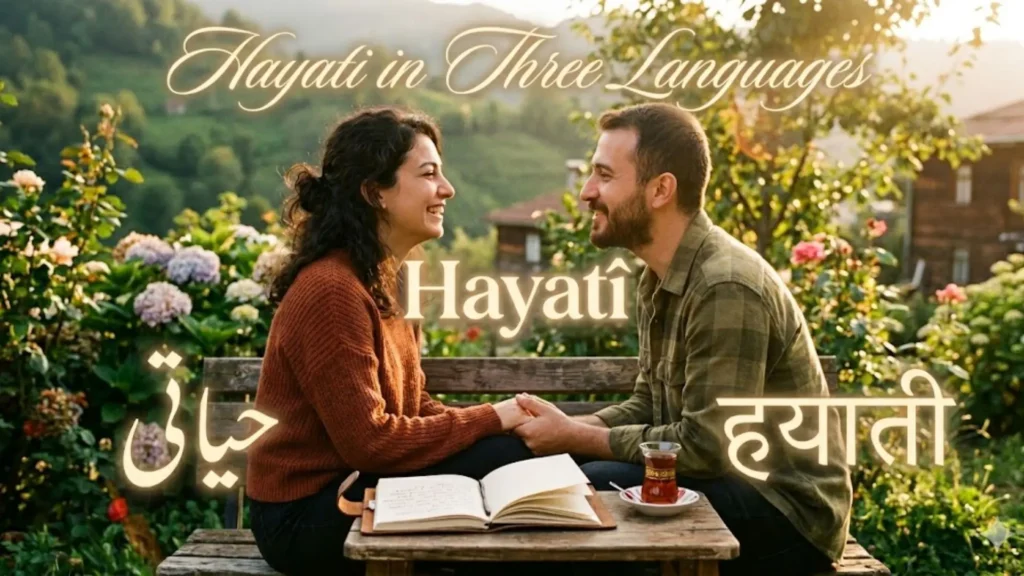
Here’s something most articles completely ignore — and it’s actually one of the most interesting connections around this word. If you’re Pakistani, Indian, or Turkish and hayati felt oddly familiar the first time you heard it, that’s not a coincidence. These languages share deep historical and cultural roots with Arabic, and the emotional vocabulary overlaps in ways that are genuinely beautiful. Urdu in particular borrowed heavily from Arabic over centuries — so when you hear hayati, your heart already knows what it means even before your brain catches up.
Take a look at how each language expresses the exact same feeling:
| Language | Equivalent | Meaning | Connection to Hayati |
| Urdu / Hindi | جان (Jaan) | My Life / My Soul | Directly borrowed emotional weight from Arabic — same intimacy, same depth |
| Turkish | Hayatım (Hayatim) | My Life | Almost identical — hayat is Arabic, “-ım” is the Turkish possessive suffix for “my” |
| Persian / Farsi | جانم (Jaanam) | My Life / My Darling | Shares the same soul-level intimacy as hayati |
The Turkish connection is especially worth noting. Hayatım and hayati are essentially the same word — just dressed in different grammar. Both come from the Arabic root حياة (Hayah) meaning life. Ottoman Turkish absorbed thousands of Arabic words, and hayat (life) was one of them. So when a Turkish person says “hayatım” to someone they love, they’re unknowingly reaching back into the same Arabic linguistic well. And for Urdu speakers, jaan carries every bit of the same emotional intensity as hayati — you are not just loved, you are someone’s very breath. That’s a feeling that crosses every border effortlessly.
Common Mistakes to Avoid
Learning a word like hayati is exciting — but using it wrong can create some genuinely awkward moments. The good news is that the mistakes people make are predictable, and once you know them, you won’t fall into the same traps. These aren’t grammar technicalities either. They’re real, practical slip-ups that even well-meaning people make when they first discover this word. Here’s what to watch out for:
- ❌ Using it with strangers or acquaintances Hayati isn’t small talk. It carries deep emotional weight and dropping it casually with someone you barely know will feel uncomfortable — even offensive in some contexts. Save it for people who genuinely matter to you.
- ❌ Mispronouncing it as “hay-ti” This is the most common mistake by far. Rushing through the syllables kills the word’s natural flow. Remember — it’s ha-yaa-tee, not hay-ti. Stretch that middle syllable and let it breathe.
- ❌ Assuming it’s only romantic This one surprises a lot of people. Hayati isn’t exclusively for couples — Arabic mothers say ya hayati to their children every single day. It’s one of the most natural parenting expressions in the Arab world. Don’t limit it to romance only.
- ❌ Confusing Hayati with Habibi They’re not interchangeable. Habibi is warm and casual — you’ll hear it between friends and even strangers. Hayati meaning goes much deeper — it’s reserved, intentional, and far more emotionally loaded than habibi ever is.
FAQs
Can you say Hayati to a girl?
Yes — the word stays the same. Just change the pronoun: “Anti hayati” for a female.
What does “Ya Hayati” mean?
Ya hayati means “Oh my life.” The “ya” is used in Arabic when calling out to someone affectionately.
Is Hayati romantic only?
No. Arabic mothers say ya hayati to their children daily — it works for family and close friends too.
What is stronger — Habibi or Hayati?
Hayati is stronger. Habibi means “my love” and is used casually — hayati means “you are my life” and runs much deeper.
How do you write Hayati in Arabic?
Hayati in Arabic is written as حياتي.
What does Inta Hayati mean?
Inta hayati (انت حياتي) means “You are my life” — addressed to a male.
Is Hayati used in Turkish?
Yes — the Turkish equivalent is Hayatım, which also means “my life” and comes from the same Arabic root.
Can you say Hayati to a friend?
Only to a very close friend. It signals an exceptionally deep bond — not casual like habibi.
What is the difference between Hayati and Roohi?
Hayati means “my life” — Roohi (روحي) means “my soul” and is considered even more intense.
Where did the word Hayati come from?
From the Arabic root ح-ي-و (H-Y-W), meaning life. Base word حياة (Hayah) + suffix “-i” (my) = Hayati.
Conclusion
Now you know that hayati is far more than just a word. It means “my life” — but it carries the weight of your whole world in two syllables. From Arabic poetry to TikTok songs, from a mother calling her child to a husband texting his wife, hayati meaning has always been the same — you matter deeply, completely, and without question.
So don’t just keep it to yourself — use it. Say it to someone who deserves it. And if you enjoyed learning about hayati, you’ll love going deeper into Arabic terms of endearment.




Leave a Reply