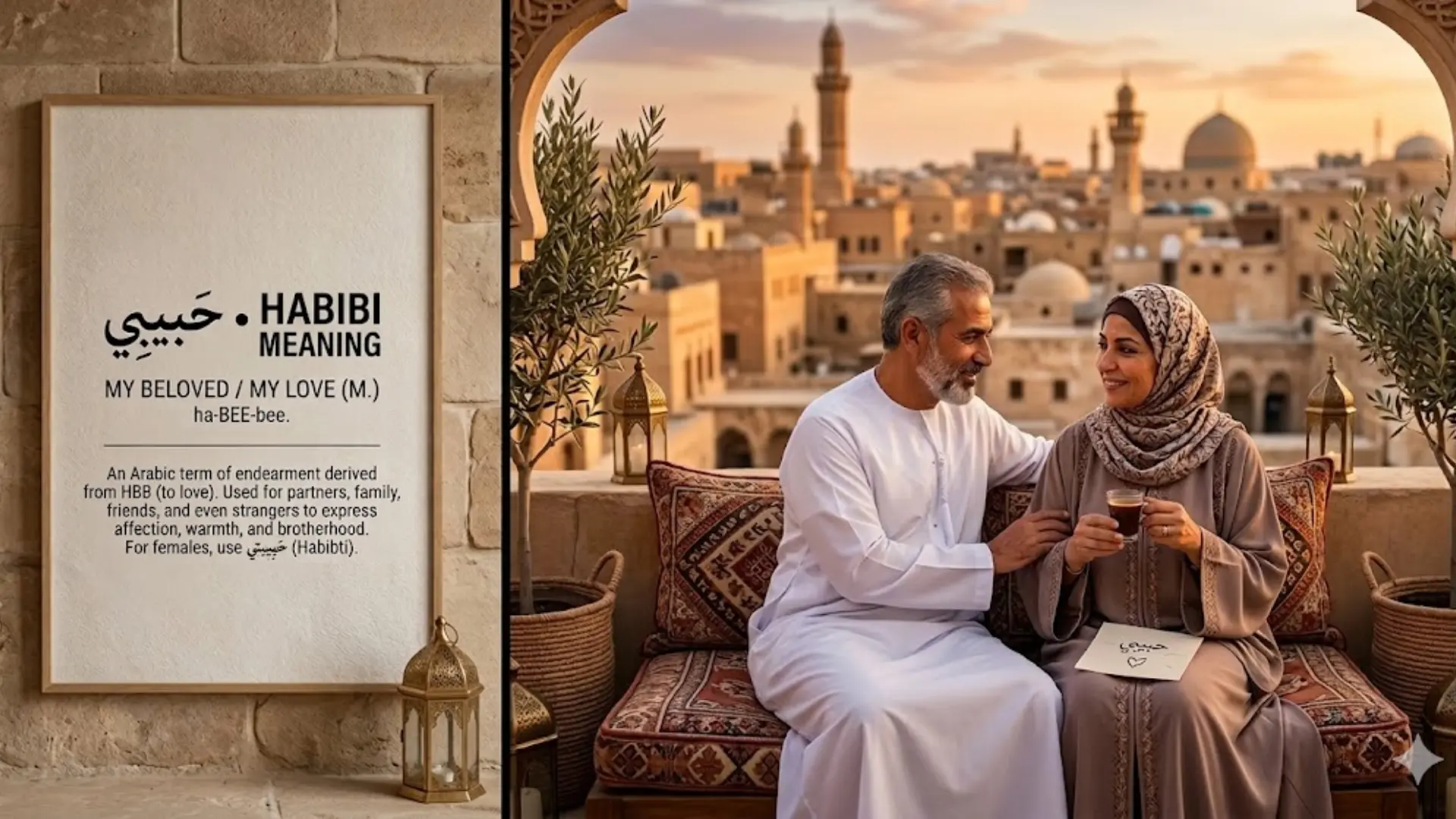
Someone texted you “ya habibi” and now you’re staring at your screen wondering — is that romantic? Is it friendly? Are they flirting, or is this just how they talk? Maybe you heard it in a Drake song, caught it on a TikTok trend, or your Arab friend says it to literally everyone and you still can’t figure out what it actually means. You’re not alone. Millions of people from Western countries, South Asia, and Australia search this exact thing every day — and most of the answers they find are way too vague to actually help.
So let’s clear it up right now. Habibi meaning in Arabic is “my beloved,” “my dear,” or “my darling” — but that’s only the beginning of the story. It comes from the Arabic root H-B-B (حبّ), which is the foundation of love in the Arabic language. It’s not always romantic. In the UAE, Lebanon, and across the Arab world, people use it with friends, family, strangers, even shopkeepers. And yes — there’s a female version too. If someone says habibti to a woman, it means the exact same thing, just with the right gender. Using the wrong form? That’s a rookie mistake Arabic speakers notice instantly.
This guide covers everything you genuinely need. You’ll learn what habibi means in text, in a relationship, in casual chat, and in different cultural settings. You’ll see why it blows up on WhatsApp and Instagram, how it shows up in music and memes, when it’s sweet and when it gets awkward, and exactly how to use it — or reply to it — without embarrassing yourself. Whether you’re curious, confused, or just want to impress your Arabic-speaking friends, by the end of this article you’ll know habibi better than most people who use it every day.
What Does Habibi Mean?
Habibi (حبيبي) means “my love,” “my dear,” or “my beloved” in Arabic — and it’s used for males. That’s the short answer. But here’s what none of the dictionary definitions tell you: this one little word carries an entire spectrum of feeling. It can be romantic, warm, playful, or even sarcastic depending on who says it and how. If you’ve heard it and felt confused about what it actually meant in that moment, you’re not misreading it — the word genuinely shifts meaning with context.
What makes habibi so special is that it isn’t locked inside romance the way “I love you” is in English. A mother calls her son habibi. Friends use it on a daily basis. A shopkeeper in Beirut or Dubai might say it to a customer he’s never met. It’s an Arabic term of endearment that reflects warmth, closeness, and social bonding all at once — and that’s exactly why the rest of the world has fallen in love with it too.
Habibi Meaning in English — The Literal Translation
The most direct habibi meaning in English is “my love” — but “my dear” and “my beloved” are equally accurate translations. The word breaks down simply: habib means “beloved” or “dear one,” and the suffix -i means “my.” Put them together and you get “my beloved.” In English, the closest equivalents are darling, sweetheart, or honey — but none of them carry quite the same cultural weight that habibi does in Arabic.
The Core Feeling Behind the Word
Think of habibi less like a label and more like a tone. When someone says it to you, they’re not just picking a word — they’re wrapping it in warmth. It signals that you matter to them, whether you’re their partner, their best friend, or even just someone they’re being kind to. That feeling of being seen and valued is exactly why habibi has crossed borders, languages, and cultures. It doesn’t just translate — it resonates.
Habibi Meaning in Arabic: Roots, Grammar, and Structure
Arabic is one of the most systematic languages on the planet — and once you understand how it works, habibi meaning in Arabic suddenly makes perfect sense. Every Arabic word is built on a three-consonant root. These three letters carry a core idea, and then the language builds dozens of words around that same root by changing vowels, adding prefixes, or attaching suffixes. It’s like a tree: one root, many branches. For habibi, that root is ح-ب-ب (H-B-B) — and it means love.
That root alone gives Arabic the entire universe of love-related words. From it comes hubb (love), habib (beloved), mahbub (the one who is loved), and of course habibi — my beloved. The tiny suffix -i at the end does all the heavy lifting. It simply means “my.” So when someone says habibi to you, they’re not just using a pet name. They’re saying: you are my beloved. And that possessive — that “my” — is what makes it feel so personal and warm every single time.
The Arabic Root H-B-B (حبّ) Explained
The root H-B-B (حبّ) is the heartbeat of the Arabic word for love. In Arabic grammar, this is called a tri-literal root — three consonants that carry a shared meaning. Almost every Arabic word related to love, affection, or endearment traces back to this exact root. Here’s how it branches out:
| Arabic Word | Pronunciation | Meaning |
| حُبّ (Hubb) | Hoob | Love |
| حَبيب (Habib) | Ha-beeb | Beloved / Dear one |
| حَبيبي (Habibi) | Ha-bee-bee | My beloved (masculine) |
| حَبيبتي (Habibti) | Ha-beeb-tee | My beloved (feminine) |
| مَحبوب (Mahbub) | Mah-boob | The loved one |
| يُحِبّ (Yuhibbu) | Yu-hib-bu | He loves |
| حَبيبة قلبي (Habibat qalbi) | — | Love of my heart |
Once you see the H-B-B root inside each word, you can’t unsee it. That’s the beauty of Arabic word families — learning one root unlocks an entire cluster of related words.
How the Possessive Suffix “-i” Makes It Personal
Here’s the grammar bit — and it’s simpler than it sounds. In Arabic, you attach short suffixes to words to show possession. The suffix “-i” means “my.” So:
- Habib = beloved
- Habib + i = Habibi = my beloved
That’s it. One letter. But that one letter completely transforms the word. It shifts from a general description into something intimate and direct. When someone says habibi, they’re not saying “a dear person.” They’re saying you are my dear person. That small possessive detail is exactly why the word hits differently than just saying “friend” or “love” in English.
This same pattern works across Arabic endearment words too:
- Hayat (life) → Hayati (my life)
- Ruh (soul) → Rouhi (my soul)
- Qalb (heart) → Qalbi (my heart)
See the pattern? The “-i” suffix turns any noun into something personal and affectionate. It’s one of the most powerful little tools in the Arabic language.
Where Habibi Sits in Arabic Word Families
Habibi doesn’t exist in isolation — it belongs to a rich family of words all rooted in love. Understanding this helps you see why Arabic speakers use it so naturally and so often. Within the broader Semitic language family — which includes Arabic, Hebrew, and Amharic — the H-B-B root appears across languages, which is why you’ll hear something very similar in Hebrew too. These languages share ancient Semitic roots going back thousands of years, and love, it turns out, has always sounded a little like habibi.
In Classical Arabic and Quranic Arabic, the root H-B-B carries spiritual significance as well. The phrase Habib Allah — meaning “Beloved of God” — is one of the titles used for Prophet Muhammad. So this root doesn’t just live in casual conversation. It runs through poetry, scripture, music, and daily life — which tells you everything about how deeply the concept of love is woven into Arabic culture and language.
Habibi vs Habibti: Gender Forms and When to Use Each
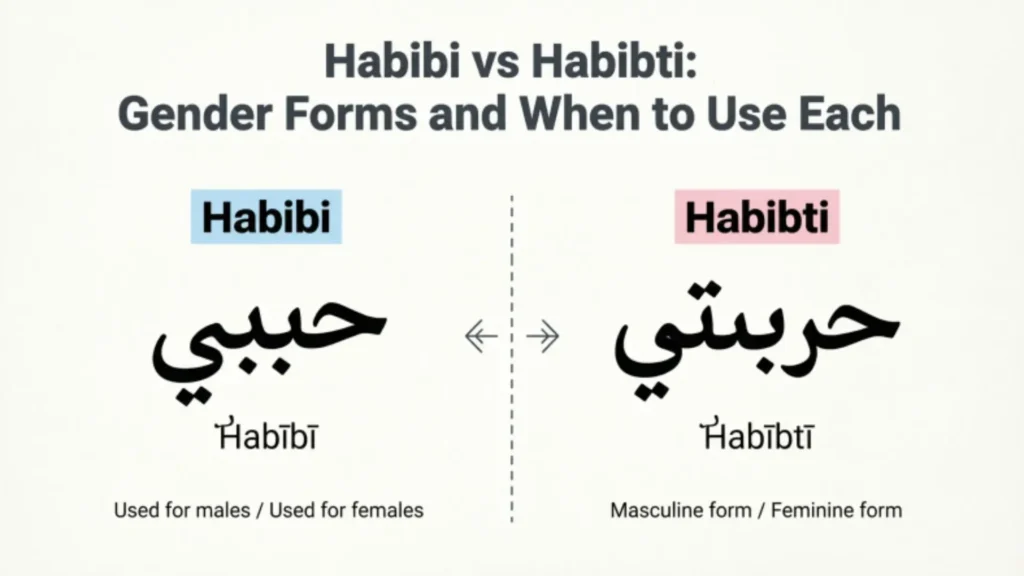
Arabic is a gendered language — and that means the word you use changes depending on who you’re talking to. This is one of the most common mistakes non-Arabic speakers make with habibi. They learn the word, love it, start using it with everyone — and without realizing it, they’re calling women by the wrong form. It doesn’t cause huge offense most of the time, but Arabic speakers do notice. And if you want to use the word properly, this is the one rule you genuinely can’t skip.
The simple version: use habibi when speaking to a male, and habibti when speaking to a female. That’s the whole rule. But understanding why it works this way — and knowing the situations where it gets a little more complicated — is what separates someone who uses the word naturally from someone who just googled it once.
Habibi — The Masculine Form
Habibi (حبيبي) is the masculine form, and it’s the one that went global. When you hear it in Drake songs, TikTok videos, or WhatsApp messages, this is almost always the version being used. It’s directed at males — a boyfriend, a brother, a friend, a son, or even a stranger you’re being warm with. The pronunciation is ha-bee-bee, with a soft stress on the middle syllable.
Here’s where it gets interesting: habibi is also used in mixed or general contexts when someone isn’t thinking about gender — especially in Western countries or online spaces where Arabic is used casually. Think of it like how English speakers use “guys” for a mixed group. Technically masculine, but widely accepted as neutral in many settings.
Habibti — The Feminine Form
Habibti (حبيبتي) is the feminine form — same root, same meaning, just with a feminine suffix. It’s pronounced ha-beeb-tee. Use it when speaking to a woman — a girlfriend, a mother, a sister, a close female friend. In Arabic-speaking communities, women use habibti with each other constantly. It’s warm, natural, and completely platonic between female friends, just as habibi is between male friends.
One thing worth knowing: habibti actually sounds softer and more tender to many Arabic ears than habibi does. There’s something about the -ti ending that feels gentle and nurturing — which is probably why you hear mothers use it so often with their daughters.
Cross-Gender Usage and Common Mistakes
Here’s the real-world situation people actually ask about: can a woman say habibi to a man, or a man say habibti to a woman?
Technically, no — that would be grammatically incorrect in Arabic. But in casual, modern usage — especially online, in music, and across Western diaspora communities — people sometimes mix the forms without it being a big deal. Context and tone do a lot of the work.
The most common mistakes to avoid:
- Calling a woman “habibi” — use habibti instead
- Calling a man “habibti” — this sounds odd and can come across as unintentionally feminine
- Using either form in a formal or professional setting — neither belongs in a business email or with your boss
- Overusing it with strangers — especially in conservative or traditional contexts, jumping straight to habibi can feel too familiar too fast
The table below makes the choice simple:
| Situation | Who You’re Talking To | Correct Form |
| Talking to a male friend | Male | Habibi (حبيبي) |
| Talking to a female friend | Female | Habibti (حبيبتي) |
| Romantic partner (male) | Male | Habibi (حبيبي) |
| Romantic partner (female) | Female | Habibti (حبيبتي) |
| Parent to son | Male child | Habibi (حبيبي) |
| Parent to daughter | Female child | Habibti (حبيبتي) |
| Online/casual mixed group | Mixed/unknown | Habibi (commonly used as neutral) |
The Origin and Cultural History of Habibi
Some words are just words. Habibi is not one of them. This word has been alive for over a thousand years — spoken in desert tents, written in classical poetry, recited in Quranic verses, sung by Arabic music legends, and now typed on phones by teenagers in London, Lagos, and Los Angeles. That kind of journey doesn’t happen by accident. It happens because a word carries something real inside it — something that connects people across time, language, and culture. To truly understand habibi meaning, you have to understand where it came from and how it got here.
The word traces back to the Arabic root H-B-B (حبّ), which has existed in the Arabic language since its earliest recorded forms. Classical Arabic — the formal, literary Arabic used in poetry, scholarship, and religious texts — used this root constantly to express love, devotion, and deep human connection. It wasn’t slang. It wasn’t casual. It was one of the most serious and beautiful words in the language. And over centuries, as the Arabic language spread across the Middle East, North Africa, and beyond through trade, migration, and Islamic scholarship, habibi travelled with it.
Classical Arabic and Quranic Roots
The root H-B-B appears in the Quran — and that alone tells you how central this concept of love is to Arabic culture. One of the most significant uses is in the title Habib Allah — meaning “Beloved of God” — a title given to Prophet Muhammad in Islamic tradition. This wasn’t casual usage. It was one of the most elevated expressions of love and closeness in the entire Arabic spiritual vocabulary.
In Classical Arabic literature, the word habib appeared in some of the greatest poetry ever written in the Arabic language. Ancient Arab poets used it to address beloved ones in odes called qasidas — long, flowing poems about love, loss, and longing. The word carried weight. It carried dignity. Using it meant something deep — and that emotional seriousness is still baked into the word today, even when it’s said casually between friends.
How the Word Evolved Over Centuries
Languages don’t stay frozen — they breathe and change with the people who speak them. Over centuries, habibi moved from the elevated world of Classical Arabic poetry into the daily spoken language of ordinary people across the Arab world. By the time of medieval Arab civilization — when cities like Baghdad, Cairo, and Córdoba were cultural powerhouses — habibi was already a living, breathing part of everyday speech.
As Arabic dialects developed across different regions, habibi adapted too. Gulf Arabic, Levantine Arabic, Egyptian Arabic, and North African Arabic all kept the word — but each gave it a slightly different flavor in terms of tone and frequency of use. In Egypt, for example, it became incredibly common in casual street conversation. In the Gulf, it carried a bit more warmth and formality. In Lebanon, it was used freely between strangers as a sign of hospitality. Same word, different textures — all rooted in the same ancient origin.
Habibi in Arabic Poetry and Literature
Arabic poetry is one of the oldest and most celebrated literary traditions in the world — and habibi sits right at the center of it. Pre-Islamic Arabic poets, known as the Shu’ara al-Jahiliyya (poets of the pre-Islamic era), wrote passionately about love and addressed their beloveds with terms rooted in H-B-B. Later, during the Islamic Golden Age, poets like Ibn Arabi and Rumi’s Arabic-influenced contemporaries used similar endearments to describe both human and divine love.
What’s remarkable is how this poetic tradition kept the word emotionally charged across generations. When Amr Diab sings habibi in a modern Egyptian pop song, or when it appears in a Bollywood-style Arabic film on Netflix, it carries echoes of that thousand-year poetic history. The word didn’t survive this long by being ordinary. It survived because it genuinely captures something that people in every generation have needed to say — you are my beloved — and nothing else quite says it the same way.
How to Pronounce Habibi the Right Way
Most non-Arabic speakers say habibi close enough to be understood — but there’s one sound that gives almost everyone trouble. Getting the pronunciation right isn’t about being perfect. It’s about not accidentally sounding awkward when you use it with an Arabic speaker. The good news? Once you break it down syllable by syllable, it clicks fast.
Habibi has three syllables: ha – bee – bee. The stress lands on the middle syllable — ha-BEE-bee. Say it almost like a little rhythm. The ending flows softly — don’t cut it short or swallow the last syllable. Most English speakers get this part right naturally.
Syllable Breakdown (Ha-Bee-Bee)
Here’s the full pronunciation guide in one quick table:
| Syllable | Sound | Tip |
| Ha | Soft H — like “huh” but lighter | Not a hard English H |
| BEE | Long “ee” sound — stressed | This is the emphasized syllable |
| bee | Same “ee” again — softer | Let it trail off gently |
Full pronunciation: ha-BEE-bee — smooth, flowing, three beats.
Common Mispronunciations to Avoid
A few mistakes come up again and again with non-Arabic speakers:
- “HAB-ibi” — wrong stress on the first syllable
- “Ha-BIB-i” — turning the middle into “bib” instead of “bee”
- “Habeeeebi” — overdragging it sounds theatrical, not natural
- Dropping the last syllable — saying “ha-bee” cuts the word in half
Audio Tips for Non-Arabic Speakers
The trickiest part is the ح (Ha) sound — Arabic’s version of H. It’s not the same as the English H in “hello.” It’s slightly breathier, like you’re gently fogging up a mirror. Native speakers produce it from the throat, not the lips. You don’t have to nail it perfectly as a non-native speaker — but softening your H instead of hardening it gets you much closer to the real thing. Practice saying it slowly: ha-bee-bee. Then speed it up. Three beats, smooth flow, soft landing.
Habibi Meaning in Text, Chat, and Messaging Apps
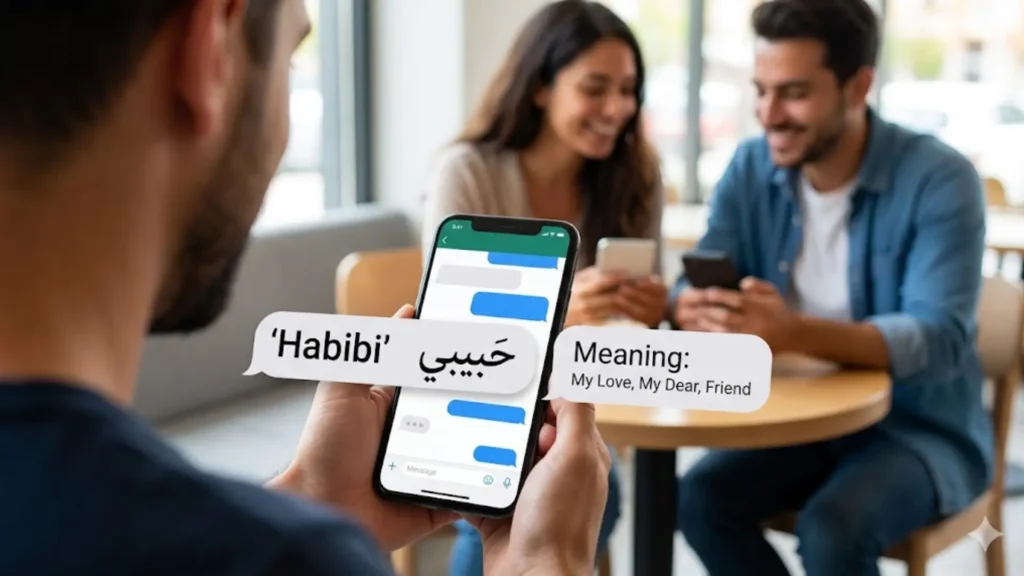
Habibi meaning in text isn’t always the same as habibi meaning in real life. In face-to-face conversation, tone of voice does half the work. In a WhatsApp message or Instagram comment, the words carry everything alone. So the same word can read as affectionate, playful, sarcastic, or even passive-aggressive — purely depending on context. Understanding how habibi travels through digital communication is genuinely useful, especially if you’re talking with Arabic speakers regularly online.
The word fits naturally into casual digital conversation without feeling forced or formal. That ease is exactly why it stuck across messaging apps, social media, and even dating platforms worldwide.
Habibi Meaning in Text Conversations
In text, habibi works across a wide range of everyday situations. Here’s how Arabic speakers actually use it in chat:
- “Hey habibi, how are you?” — warm, friendly greeting
- “Habibi, can you call me later?” — polite and affectionate request
- “Yalla habibi, where are you?” — playful impatience
- “Take your time, habibi…” — light sarcasm or mild frustration
- “Goodnight habibi” — genuine intimacy between partners
- “Thanks habibi!” — casual warmth, like saying “thanks mate”
The sarcastic use surprises most non-Arabic speakers — but it’s completely natural in Arabic digital conversation.
Habibi in WhatsApp Chats — Real Examples
WhatsApp is where habibi lives most comfortably in the digital world. Across the Middle East, North Africa, and Arab diaspora communities, it appears in everyday chats constantly. Real examples you’d genuinely see:
- “Wallah habibi, I missed you” — sincere and warm
- “Shukran habibi, you’re the best” — grateful and affectionate
- “Habibi please, not now” — soft but firm
- “Sabah al-khair habibi” — classic warm morning greeting
These mirror real spoken Arabic — habibi carries the same warmth in text as it does out loud.
How Tone Changes Habibi’s Meaning Online
Same word, completely different meanings depending on how it’s written:
- “habibi” + heart emoji reads as romantic
- “habibi…” with ellipsis signals disappointment or frustration
- “HABIBI” in capitals feels dramatic or urgent
- “habibi lol” is purely casual and playful
- “habibi.” with a full stop can actually sound cold or final
Platform context matters too. The same word hits differently on a dating app versus a family WhatsApp group versus a TikTok comment. Arabic speakers navigate these shifts instinctively — and now you can too.
Habibi Meaning in Love and Romantic Relationships
Habibi meaning in love goes deeper than most people expect. In a romantic relationship, it isn’t just a pet name — it’s a daily expression of closeness. Arabic-speaking couples use it constantly, the way English speakers say “babe” or “honey.” But what makes it different is the weight behind it. The word literally means “my beloved” — and in a romantic context, that possessive “my” carries real emotional intention.
That said, not every habibi between two people is romantic. Context and tone decide everything. A soft “habibi” whispered privately means something completely different from a casual “habibi” in a group chat. Arabic speakers understand this instinctively — and once you do too, the word starts making much more sense.
When Habibi Becomes Truly Romantic
Habibi crosses into romantic territory when used with intention — in private, with a softer tone, or paired with other affectionate phrases. Signs it’s being used romantically:
- Said slowly and softly, not as a quick casual mention
- Paired with phrases like ana uhibbuka habibi — “I love you, my beloved”
- Used consistently by a partner throughout the day
- Combined with deeper Arabic love words like hayati or rouhi
Habibi Between Partners — Real Relationship Context
In Arab relationships, habibi replaces the partner’s name in everyday conversation. A husband calls his wife habibti throughout the day — not just in emotional moments. It shows up in ordinary exchanges like “habibti, did you eat?” or “come here, habibi.” This constant use keeps warmth alive in the relationship. It’s less of a grand declaration and more of a quiet, steady reminder — you are my person.
Habibi on Dating Apps — Flirty or Serious?
On dating apps, habibi sits somewhere between flirty and forward. An Arab user dropping habibi early in conversation is usually being warm and charming — not declaring love. For non-Arabic speakers receiving it, it can feel intense at first. But most of the time it’s the equivalent of “hey gorgeous” or “hey darling” — friendly with a flirty edge. If it feels natural, the conversation is probably going well.
Habibi Meaning in Friendship, Family, and Everyday Life
Here’s what most non-Arabic speakers get wrong — they assume habibi is mainly romantic. It isn’t. In Arab culture, habibi is used far more often between friends and family than between romantic partners. It’s genuinely one of the most common words in everyday Arabic conversation. A father says it to his son. Two male friends say it to each other constantly. A grandmother says it to her grandchild. None of that is romantic — it’s just warmth, and Arabic culture has a lot of it.
This everyday, non-romantic use is actually what makes habibi so special. English doesn’t really have an equivalent. You can’t call your male friend “my beloved” in English without it being weird. In Arabic, you can — and it’s completely normal. That cultural gap is exactly why so many non-Arabic speakers find the word confusing at first.
Habibi Between Friends — Completely Normal
Male friends in Arab culture use habibi with each other freely and constantly — in person, in group chats, over voice notes. It signals closeness, loyalty, and genuine affection without any romantic meaning whatsoever. Think of it as the Arabic version of “bro” or “mate” — but warmer and more heartfelt. Common examples between friends:
- “Wallah habibi, you always come through”
- “Miss you habibi, when are you back?”
- “Habibi, I need your advice on something”
Habibi in Family Settings — Parents, Siblings, Elders
Inside Arab families, habibi flows in every direction. Parents use it with children, children use it with parents, siblings use it with each other. It’s one of the first Arabic words children hear growing up — and it creates a lifelong emotional association with safety and love. A mother comforting her child says “habibi, it’s okay.” A father proud of his son says “that’s my habibi.” Elders use it to address younger family members as a term of respect and tenderness combined.
Habibi with Strangers — When Arabs Use It Casually
This one surprises people most. In many Arab countries — especially Lebanon, Egypt, and across the Gulf — habibi is used freely with complete strangers in casual settings. A shopkeeper in Beirut might say “shukran habibi” to a customer he’s never met. A taxi driver in Dubai might greet you with “yalla habibi, get in.” It’s not overly familiar or inappropriate — it’s hospitality. It signals warmth and friendliness in the same way Australians say “mate” or Americans say “buddy” to strangers.
Habibi on Social Media: TikTok, Instagram, WhatsApp, and Dating Apps
Habibi didn’t just travel the world through migration and music — social media turbo-charged it. Platforms like TikTok and Instagram took a word that was already beloved across the Arab world and pushed it into the feeds of millions of people who had never heard a single word of Arabic before. Today, habibi appears in viral videos, trending captions, meme formats, and dating app openers across every continent. It’s one of those rare words that crossed the language barrier almost entirely through the internet.
What makes it work so well online is how it sounds. Habibi is melodic, easy to say, and instantly warm. It doesn’t need translation to feel good. Non-Arabic speakers started using it not because they studied Arabic — but because they heard it, felt its warmth, and wanted that energy in their own conversations.
Why Habibi Exploded on TikTok
TikTok is where habibi hit a completely new audience at scale. Arabic creators, diaspora content, reaction videos, and the viral “Hamood Habibi” meme all pushed the word into global trending territory. Non-Arabic speakers started using it in comments, duets, and voiceovers — sometimes correctly, sometimes playfully wrong, but always with affection. Key reasons it thrived on TikTok:
- Short, punchy, and easy to say — perfect for video captions
- Sounds warm and exotic to non-Arabic ears
- Works for humor, romance, and friendship content equally
- The Hamood Habibi meme alone introduced it to millions of younger users globally
Habibi in Instagram Captions and Comments
On Instagram, habibi shows up in captions, comment sections, and DMs across the Arab world and beyond. Arab users drop it naturally in photos with friends — “forever my habibi” under a group shot, or “missing you habibi” under a throwback. Non-Arab users picked up the trend and started using it the same way — as a warm, affectionate label for people they care about. It’s become part of the global social media language of affection.
Habibi on Dating Apps — What It Really Signals
On dating apps, habibi is a power move — when used right. Arab users often drop it early as a term of warmth and charm rather than a declaration of love. For non-Arabic speakers on the receiving end, it can feel either flattering or overwhelming depending on how much they know about the word. What it almost always signals is genuine interest and a culturally warm communication style. It rarely means “I love you” on a first message — it usually means “I like you and I’m being warm about it.”
Habibi in Music, Movies, Memes, and Pop Culture
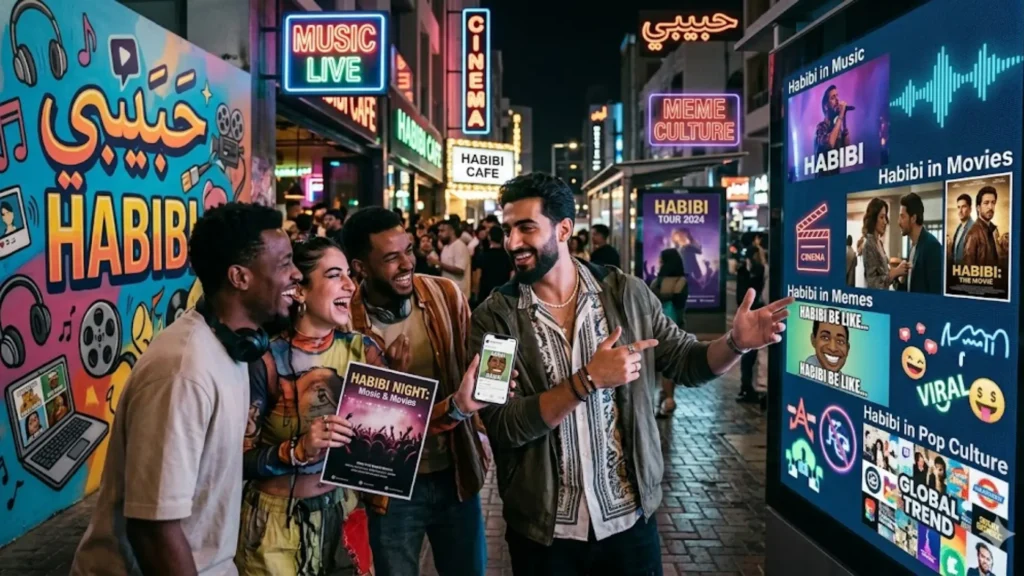
Habibi didn’t just stay in Arabic culture — it exploded into global pop culture through music, film, and the internet. Artists, filmmakers, and meme creators all played a role in pushing this one Arabic word into every corner of the world. If you’ve heard it outside of a real Arabic conversation, pop culture is probably why.
It works in entertainment because it sounds warm, musical, and instantly emotional. Audiences don’t need to speak Arabic to feel what it means — and that’s exactly why creators keep reaching for it.
Habibi in Arabic Music — Amr Diab and Beyond
Arabic pop music put habibi on the global map long before TikTok existed. Amr Diab — one of the biggest Arabic music stars in history — used habibi in songs that reached millions across the Middle East and North Africa. It became a signature word of Arabic pop, romance, and longing. Key points:
- Habibi appears in hundreds of classic and modern Arabic songs
- Amr Diab’s music introduced it to non-Arab audiences across Europe and South Asia
- The word carries an emotional pull in music that translates across languages
Drake, Western Artists, and the Habibi Trend
Western artists started borrowing habibi once Arabic culture began influencing global music more heavily. Drake referenced it in his music, bringing it into mainstream hip-hop vocabulary. Once a word lands in hip-hop, it spreads fast — and habibi was no exception. It moved from Arabic playlists into Western pop, R&B, and trap music almost overnight.
Habibi in Bollywood, Hollywood, and Netflix
Bollywood embraced habibi early — South Asian audiences already had cultural familiarity with Arabic through Islamic tradition and trade history. Hollywood and Netflix followed, using habibi in Middle Eastern-set stories to add authenticity. Today it appears in:
- Bollywood romantic tracks and dialogue
- Netflix Arabic originals and dubbed series
- Hollywood films set in the Middle East or featuring Arab characters
The Hamood Habibi Meme and Internet Culture
The Hamood Habibi meme became one of the most recognizable Arabic internet moments globally. A simple children’s song became a viral sensation — and it introduced habibi to an entirely new generation of non-Arabic speakers through humor. Memes gave the word a playful, lighthearted dimension that made it even easier for outsiders to adopt it without feeling like they were overstepping.
How Habibi Became a Global Phenomenon
A word that started in Classical Arabic poetry is now being typed by teenagers in Brazil, Australia, and Japan. That doesn’t happen by accident. Habibi’s global spread is the result of several forces all working together — migration, music, social media, and the simple fact that the word fills an emotional gap that many languages don’t have a clean equivalent for.
English has “honey” and “darling” — but they carry different cultural weight. Habibi feels more universal, more musical, and somehow more sincere. People adopted it because it gave them a warmer way to express something they already felt.
From the Arab World to Western Countries
Arab migration to Western countries — particularly to the UK, USA, France, Germany, and Australia — brought habibi into everyday multicultural life. Second and third generation Arab diaspora communities kept the word alive while blending it naturally into English conversations. It stopped being a “foreign word” and became part of multicultural street language in major cities.
Why Non-Arabic Speakers Adopted It So Fast
Three reasons habibi crossed language barriers faster than almost any other Arabic word:
- It’s easy to pronounce — three simple syllables
- It sounds warm and positive — no negative associations
- It fills a genuine emotional gap — English has no direct equivalent with the same weight
Habibi in Australia, South Asia, and Beyond
In Australia, habibi entered everyday slang through Arab-Australian communities in Sydney and Melbourne — now used casually by non-Arabs too. In South Asia, Bollywood and Pakistani dramas normalized it across India, Pakistan, and Bangladesh. In Turkey and Iran, shared cultural and linguistic history made the adoption even more natural. The word genuinely belongs to the world now.
When Not to Use Habibi: Professional and Cultural Boundaries
Habibi is warm and wonderful — but it doesn’t belong everywhere. Using it in the wrong setting can come across as unprofessional, overly familiar, or culturally insensitive. Knowing when to hold back is just as important as knowing when to use it.
The core rule is simple: habibi is an informal, affectionate word. The more formal or unfamiliar the situation, the less appropriate it becomes.
Habibi in the Workplace — Risky or Fine?
In Arab workplaces, habibi between close colleagues is common and accepted. But between a junior employee and a senior manager, or with someone you barely know professionally, it can feel presumptuous. In Western workplaces, it’s almost always too casual. Avoid it:
- In emails or formal written communication
- With managers, clients, or professional contacts you don’t know well
- In job interviews or formal business settings
Cultural Sensitivity and Appropriation Concerns
Non-Arabic speakers using habibi casually is generally fine — especially when it comes from a place of genuine appreciation for Arabic culture. Where it gets problematic is when it’s used mockingly, in an exaggerated fake accent, or to stereotype Arab people. Using a culture’s language should always come with respect, not caricature.
Situations Where Habibi Can Be Misread
Even in casual settings, habibi can land wrong in certain situations:
- Saying it to someone you’ve just met in a conservative cultural context
- Using it with someone who doesn’t know what it means — it can feel unexpectedly intimate
- Dropping it in a tense or conflict situation — it can read as dismissive or sarcastic
- Using it cross-gender with someone you don’t know well in a traditional setting
Habibi in Other Languages: Hebrew, Urdu, Persian, and Turkish
Arabic isn’t the only language that knows habibi. Because Arabic belongs to the Semitic language family — and because of centuries of trade, Islamic scholarship, and cultural exchange — this word found its way into several other languages in forms that feel remarkably familiar.
Habibi in Hebrew — Shared Semitic Roots
Hebrew and Arabic share ancient Semitic roots, and habibi exists in Hebrew almost identically — spelled and pronounced nearly the same way. Hebrew speakers use it as a term of endearment in casual speech, particularly in Israeli slang. The shared linguistic DNA between both languages makes this one of the clearest examples of how Semitic language families stay connected across cultures and centuries.
Habibi in Urdu and Hindi — South Asian Adoption
In Urdu and Hindi, habibi entered through Islamic cultural influence, Sufi poetry, and more recently through Bollywood music. Pakistani and Indian Muslim communities have used Arabic terms of endearment for centuries in religious and poetic contexts. Today younger South Asian audiences use habibi casually in social media, influenced heavily by Arabic music and online trends.
Habibi in Persian and Turkish — How It Crossed Borders
Persian borrowed habibi through centuries of Arabic literary and religious influence — it appears in classical Persian poetry alongside native Persian love words. In Turkish, the Ottoman Empire’s deep connection with Arabic culture left linguistic traces that are still felt today. Habibi is understood across Turkey and used informally — especially in regions with strong Arab cultural ties or large Arab diaspora communities.
Regional Differences: How Habibi Is Used Around the World
Habibi is one word — but it doesn’t sound or feel identical everywhere it’s used. Across different Arabic-speaking regions, the frequency, tone, and context of habibi shift in subtle but real ways. If you’ve ever noticed that Arabs from different countries seem to use it differently, you’re not imagining it.
Gulf Arabic — UAE, Saudi Arabia, Kuwait
In Gulf countries, habibi is used warmly but with a degree of social awareness. It flows naturally between friends and family but carries a slightly more respectful tone in formal or semi-formal settings. In the UAE especially — a multicultural hub — habibi has become part of the everyday multicultural vocabulary, used freely between Arabs and non-Arabs alike.
Levantine Arabic — Lebanon, Syria, Jordan
Levantine Arabic speakers — particularly Lebanese — use habibi with extraordinary ease and frequency. In Lebanon, it rolls off the tongue in nearly every conversation regardless of how well you know someone. Lebanese culture is famously warm and expressive, and habibi reflects that perfectly. Syrians and Jordanians use it just as naturally, though perhaps slightly less frequently than Lebanese speakers.
Egyptian Arabic — Unique Local Flavor
Egypt has its own warm relationship with habibi. Egyptian Arabic is the most widely understood dialect across the Arab world — largely because of the dominance of Egyptian cinema and music. Egyptian films and TV shows spread habibi to Arab audiences everywhere, cementing its emotional associations. In Cairo street culture, habibi is casual, fast, and constant.
North African Arabic and Western Diaspora
In Morocco, Algeria, and Tunisia, habibi coexists with local Darija dialect terms of endearment. It’s used but competes with French-influenced expressions in these heavily bilingual societies. In the Western diaspora — Arab communities in France, UK, USA, Canada, and Australia — habibi has blended into multicultural slang, often mixing naturally with English in the same sentence.
Common Habibi Phrases, Slang Variations, and Alternatives
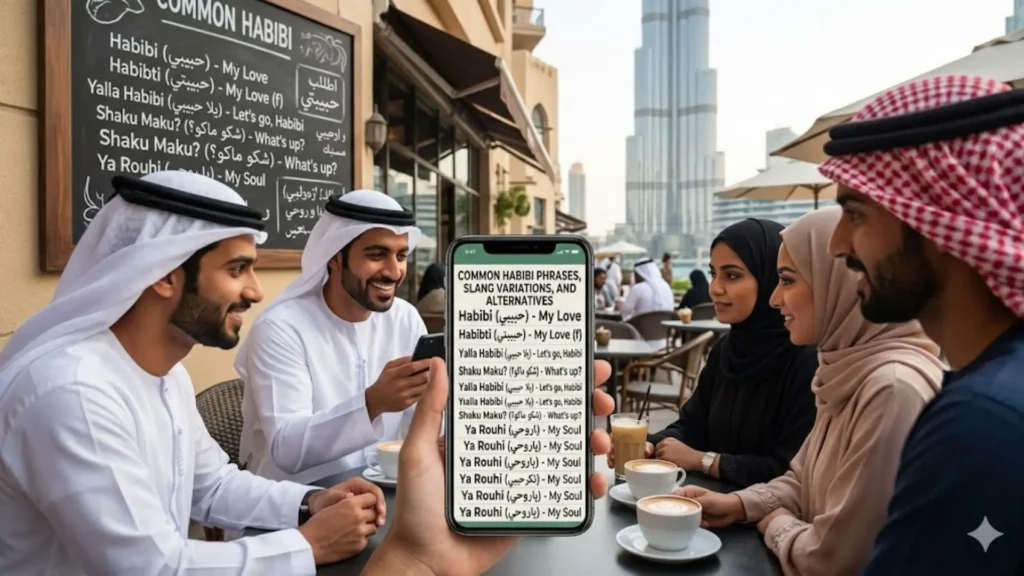
Habibi rarely travels alone. In real Arabic conversation, it pairs with other words to create expressions that carry their own distinct meanings and moods. Learning these phrases gives you a much fuller picture of how Arabic speakers actually communicate warmth and affection.
Top Habibi Phrases — Ya Habibi, Yalla Habibi, Wallah Habibi
The most common habibi phrases you’ll hear and see:
- “Ya habibi” — “Oh my dear” — adds emotional emphasis, used in affection or frustration
- “Yalla habibi” — “Come on, my dear / let’s go” — playful, energetic, very common
- “Wallah habibi” — “I swear, my dear” — adds sincerity and emphasis
- “Shukran habibi” — “Thank you, dear” — warm and grateful
- “Sabah al-khair habibi” — “Good morning, my dear” — classic affectionate greeting
- “Marhaba habibi” — “Hello/welcome, my dear” — warm and hospitable
Other Arabic Terms of Endearment — Hayati, Rouhi, Qalbi, Azizi
Habibi has company. Arabic is rich with endearment words, each carrying a slightly different emotional weight:
- “Hayati” — my life — very intimate, used between close partners
- “Rouhi” — my soul — deeply emotional, poetic
- “Qalbi / Albi” — my heart — romantic and tender
- “Omri” — my lifetime — poetic, appears often in Arabic songs
- “Azizi / Azizati” — my dear / my precious — slightly more formal
- “Ya Asal” — honey — sweet and casual
- “Ya Qamar” — my moon — romantic and lyrical
English Alternatives When Habibi Doesn’t Fit
Sometimes the setting calls for something more familiar to your audience:
- Darling, sweetheart, honey — romantic equivalents
- Dear, my dear — more formal but warm
- Babe, bae — casual and modern
- Buddy, mate, bro — platonic and casual
None of these carry habibi’s exact cultural weight — but they work when you need something your audience will immediately understand.
How to Respond When Someone Says Habibi to You
Someone just called you habibi — and now you’re not sure what to say back. Don’t overthink it. Your response depends entirely on the relationship, the context, and how the word was delivered. Here’s a simple guide for every situation.
Friendly Replies — Keeping It Casual
If a friend says habibi to you casually, match their energy:
- “Habibi!” right back — simple, warm, natural
- “Hey, how are you habibi?” — keeps it conversational
- “Wallah, missed you habibi” — adds sincerity
Flirty Replies — When You Want to Match the Energy
If the context feels romantic and you’re comfortable:
- “Habibi” back — lets it land without overexplaining
- “Only you call me that” — playful and intimate
- “Habibti is what you mean” — flirty correction if they got the gender wrong
Polite Replies — When You’re Unsure of the Intent
If you’re not sure what they meant by it:
- Smile and respond normally without using the word back
- “Thanks, that’s sweet” — acknowledges warmth without committing
- Keep your reply warm but neutral until context becomes clearer
How to Respond If You’re Uncomfortable
If habibi from this particular person doesn’t feel right:
- You don’t have to mirror it back — ever
- A simple “I prefer you use my name” is completely reasonable
- In professional settings, a calm “let’s keep it professional” is always appropriate
Cultural warmth is genuine — but your comfort always comes first.
FAQs
Can we call a girl Habibi?
No. Use habibti for girls. Habibi is the masculine form. Using the wrong form sounds grammatically incorrect to Arabic speakers.
Is saying Habibi flirting?
Not always. It depends on tone and context. Between friends it’s platonic. Between partners it feels romantic and affectionate.
What is the meaning of habibti?
Habibti means “my beloved” in Arabic — the feminine form of habibi. Used for women in romantic, friendly, and family contexts.
Why do Muslims say habibi?
It reflects Arabic culture and warmth. Prophet Muhammad is called Habib Allah — Beloved of God — making the word culturally significant.
What does habibi mean in Urdu?
In Urdu, habibi means “my dear” or “my beloved.” Borrowed through Islamic tradition and widely used in Pakistani romantic and poetic contexts.
What does habibi mean in English?
Habibi translates to “my love,” “my dear,” or “my beloved” in English. It carries more warmth and cultural depth than English equivalents.
What does habibi mean in Arabic?
In Arabic, habibi literally means “my beloved.” It combines habib — beloved — with the possessive suffix i, meaning my.
What does Yalla Habibi mean?
Yalla habibi means “let’s go, my dear” or “come on, my love.” It’s playful, energetic, and extremely common in everyday Arabic conversation.
What does habibi mean in Islam?
In Islamic context, habibi carries spiritual weight. Habib Allah — Beloved of God — is a title for Prophet Muhammad in Islamic tradition.
What does habibi mean to a girl?
If someone calls a girl habibi, it means “my dear.” Technically habibti is correct for females — but habibi is used casually sometimes.
Conclusion
Habibi is more than just a word — it’s a feeling. Whether someone says it to their partner, their best friend, or even a stranger on the street, it carries genuine warmth that very few words in any language can match. That’s exactly why the world fell in love with it.
Now you know the full habibi meaning — where it comes from, how it works across relationships, cultures, and platforms, and when to use it or hold back. You don’t need to speak Arabic fluently to appreciate what this word represents. You just need to understand the warmth behind it — and now you do.


Leave a Reply